How to Get Your Business Recommended by ChatGPT: What Actually Helps
Want ChatGPT to recommend your business? Learn how to inspect a search-backed answer, check your public business facts and choose a useful next step.
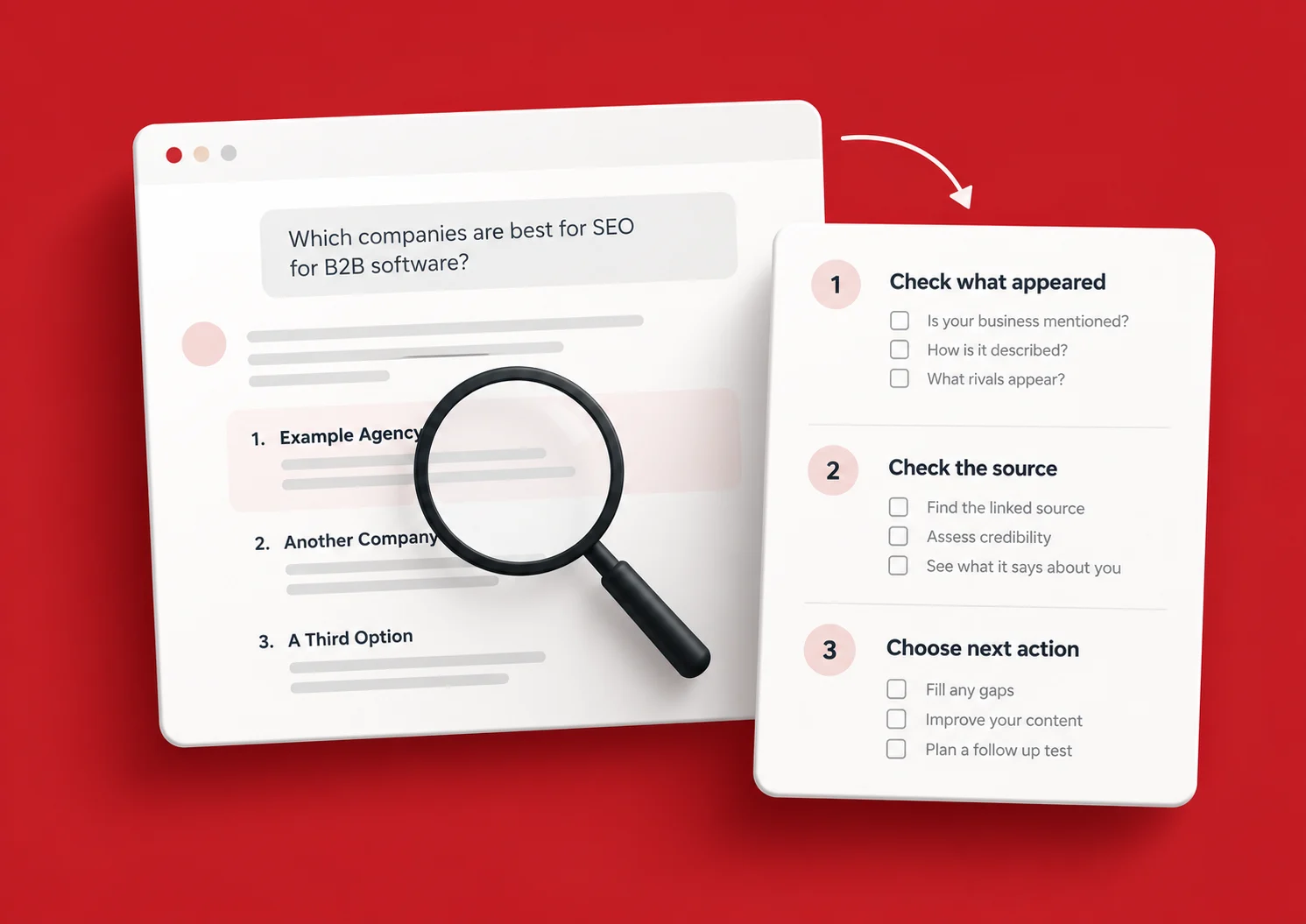
Conceptual interface showing an answer review and next-action checklist. The companies and positions pictured are illustrative, not an observed ChatGPT response or ranking.
Someone asks ChatGPT to recommend a business like yours. It names a few companies, perhaps with links explaining what they do. Your business isn't there.
Naturally, you want to know how to change that.
There is no way to guarantee that ChatGPT will recommend your business.
OpenAI does not publish a formula that lets you secure a place in its answers. But you can check whether your public website is accessible, whether the information about your business is accurate, and whether a particular answer gives you a real problem to solve.
The useful question is not simply, "How do I get mentioned?" It is "What can I verify, what genuinely needs improving, and what is outside my control?"
This guide walks you through that investigation and gives you a worksheet to decide what to do next.
Know what you are looking at
ChatGPT can search the web when a question calls for current information. A search-backed answer may name a company, cite a webpage or suggest a provider. Those outcomes are not interchangeable.
A mention means your business is named.
A citation means a source is linked.
A recommendation means the answer suggests your business as a possible choice.
An answer might do more than one of these, or none. A recommendation does not require a citation, and a citation does not necessarily mean the business was recommended.
A website visit and an actual customer inquiry are different again. If you would like the beginner explanation and illustrated examples, see Blue Kite Academy's lesson on AI mentions, citations and recommendations.
For this investigation, focus on answers that visibly use ChatGPT's web search, rather than assuming an answer without visible search represents the same process.
OpenAI explains that search-backed responses can contain links and sources, but those sources can be incomplete or incorrect. See how ChatGPT searches the web.
Start with the business facts a customer needs
Before testing a chatbot, decide which work you actually want more of. A residential electrician seeking home EV-charger installations needs different inquiries from an electrical contractor taking on large commercial projects.
Look at the service page a real customer would need. Does it explain the work offered, the customer it is suitable for, the actual service area and a sensible way to get in touch?
Where professional qualifications, licensing or experience matter, are the relevant facts accurate and appropriately verifiable?
Then look at important public information outside the website. An old directory listing might name a service you no longer provide. A staff biography might describe a role that has changed. A local listing might carry an obsolete contact number.
You don't need to rewrite your website just to please ChatGPT. The point is to establish a dependable version of the facts. Clearer, correct information helps customers assess your business whether they discover it through ChatGPT, Google or a referral. It is not a documented shortcut to being recommended.
If the page itself fails to explain an important service, our guide to writing a useful service page can help with that separate task.
Make sure your public pages can be accessed
A good page is less useful to a search system if the site prevents its search crawler from reading it.
OpenAI identifies OAI-SearchBot as the crawler used for its ChatGPT search features.
GPTBot is associated with potential model training, while ChatGPT-User handles certain user-requested visits. OpenAI documents separate purposes and controls for these agents.
Allowing model-training access is not a requirement for allowing search access.
If you manage your own website, you can ask your developer or hosting provider a narrow question: "Are our intended public service pages available to OAI-SearchBot, or are robots.txt or our security settings blocking it?"
A normal page loading in your own browser is not enough to answer that question. The person checking may need to look at crawler rules, hosting restrictions or security logs. They should not weaken security or expose private pages simply to make the site crawlable.
The starting reference is OpenAI's official crawler documentation. Access is an eligibility issue, not a recommendation guarantee.
Save the detailed technical investigation for a developer if there is an actual reason to suspect a block. Google indexing problems are separate; see why a website may not show up on Google if that is the issue you are facing.
Check a real customer question, not a trick prompt
Now you can inspect what ChatGPT actually says.
Choose a question a potential customer would naturally ask, such as "Which companies provide monthly bookkeeping for small consulting firms in Denver?" or "Can you recommend a residential electrician for a home EV charger in Portland?"
Use your real service and location, if location matters. Make sure the answer uses web search, then save the exact question and what happened.
Record the date, search mode, any location you supplied, the answer and its visible source links. If you did not see a source for a claim, write "not shown", rather than guessing where the information came from.
Next, examine one claim at a time. If the answer says a business offers a particular service, does the visible link actually support that statement? Does the business's current, verified information agree? A linked page can support one part of an answer without establishing every other statement in it.
You cannot see ChatGPT's full underlying retrieval history from an answer. A source link is evidence of what was shown, not proof of every source the system considered or which one caused a specific sentence.
Even when an answer is wrong and a directory is outdated, you should not claim that the directory caused the error unless you have separate evidence.
One saved answer is a useful observation. It is not a stable business ranking, and an answer that leaves you out does not by itself prove your website has a technical or content problem.
Choose the next action based on what you found
There are several sensible outcomes, and not all of them require publishing something new.
The answer repeats a fact that is demonstrably wrong. Check the original business evidence. Correct a page or listing you control, or ask the external publisher to update its information. Save what changed and why. You cannot promise that the next ChatGPT answer will change.
Your own service information is unclear or incomplete. Improve the existing page for the customer who needs it. For example, clarify whether a consultancy offers ongoing support or only one-off projects. Do not invent a service, location or credential just to match a search query.
There is credible evidence that intended public pages may be blocked. Give the access question to your developer, with the page URL and the suspected restriction. This is a focused technical check, not a reason to turn off website security.
Your business is simply absent from one answer. Record it, but don't assume the omission reveals a defect. If you cannot identify an inaccurate fact, an unclear page or an access problem, the right decision may be "not enough evidence to change anything yet."
That final outcome matters.
A useful investigation should be able to say that no correction is justified, rather than inventing extra SEO work.
Your ChatGPT visibility and next-action worksheet
You can copy this short worksheet for one customer question and complete it using what you can verify. It is not a scorecard or a list of guaranteed ranking factors.
| What to record | Your notes |
|---|---|
| Business objective | Which real service and customer need matter? ____________________ |
| Question and context | Exact question, supplied location, ChatGPT search mode and date: ____________________ |
| What appeared | Mention, citation, recommendation, no relevant appearance, or a combination: ____________________ |
| Specific claim | The exact statement you need to check, if any: ____________________ |
| Visible source | Shown URL, or "not shown": ____________________ |
| What the source supports | Confirmed, contradicted or unknown, and why: ____________________ |
| Business evidence | Current owner-confirmed page, listing or independent record: ____________________ |
| Next action and reason | Fix, investigate, retain, or leave unresolved: ____________________ |
| Responsibility and follow-up | Who will act, and how will completion be checked? ____________________ |
Here's how two businesses could use the same worksheet and reach different decisions.
Example 1: A recommendation contains an incorrect service claim
This is a fully fictional example. Neither the company nor the ChatGPT answer has been tested or observed. The date and source shown below are invented to demonstrate how to fill out the worksheet.
Pinecrest Interiors is an imaginary Denver design studio that works on residential interiors only. In our fictional scenario, a search-backed ChatGPT answer recommends it for a small retail-store project. The answer links to an outdated directory entry that labels the studio as offering commercial interior design.
| Worksheet field | Fictional completed record |
|---|---|
| Business objective | Get more qualified residential design inquiries, not retail projects. |
| Question and context | "Which Denver interior designers can help fit out a small retail store?" ChatGPT web search, Denver supplied, illustrative test dated Nov 1, 2026. |
| What appeared | A recommendation naming Pinecrest, with a visible directory citation. |
| Specific claim | "Pinecrest offers commercial retail interior design." |
| Visible source | A made-up directory listing, represented here by https://example.com/pinecrest-interiors (illustrative URL, not a real directory record). |
| What the source supports | The imagined listing describes the studio as commercial. It does not independently verify the service is currently offered. |
| Business evidence | Owner-confirmed services and the current company website say residential interiors only. |
| Next action and reason | Request a correction to the outdated listing. Keep the actual residential offering clear on the website. Do not add a retail-service page or claim the listing caused ChatGPT's answer. |
| Responsibility and follow-up | Owner submits the directory edit and records the request date. A team member checks the listing after the publisher responds. A later AI answer is logged separately. |
The useful result here is a real public-information correction. Even if ChatGPT never repeats the same answer, the outdated listing was worth fixing because it misrepresents the business to potential customers.
Example 2: The business is missing, but no defect is established
This is also a fictional exercise, not a real ChatGPT test or a finding about an actual company.
Willow Lane IT is an imaginary company offering remote IT support to small offices in Portland. In the illustration, ChatGPT suggests several other providers but doesn't name Willow Lane.
| Worksheet field | Fictional completed record |
|---|---|
| Business objective | Help Portland small offices find the company's remote IT support. |
| Question and context | "Which Portland firms offer ongoing remote IT help to small offices?" ChatGPT web search, Portland supplied, illustrative test dated Nov 1, 2026. |
| What appeared | No Willow Lane mention, citation or recommendation in this single answer. |
| Specific claim | No claim about Willow Lane was made. |
| Visible source | None about Willow Lane; other companies' links do not explain this omission. |
| What the source supports | Nothing about Willow Lane's eligibility or quality. The reason for the omission is unknown. |
| Business evidence | The fictional owner confirms the remote-support service page and contact details are accurate. Searchbot access has not been independently checked. |
| Next action and reason | Record the observation. No page rewrite or bot-setting change is justified by this result alone. Investigate access only if other evidence suggests a problem. |
| Responsibility and follow-up | Owner keeps the dated record and reviews genuine website issues through the normal SEO plan, without treating one missing mention as an emergency. |
This second worksheet is just as useful as the first.
No demonstrated problem means no automatic fix.
The owner doesn't have to publish another article, create a new page or hire someone to promise a ChatGPT ranking.
What counts as progress?
If you correct a public listing, you can verify whether the listing changed. If you improve a service page, you can check that its information is accurate and its contact route works. Those are completed actions you can document.
An AI answer changing later is a separate observation. It does not, by itself, prove your edit caused the change.
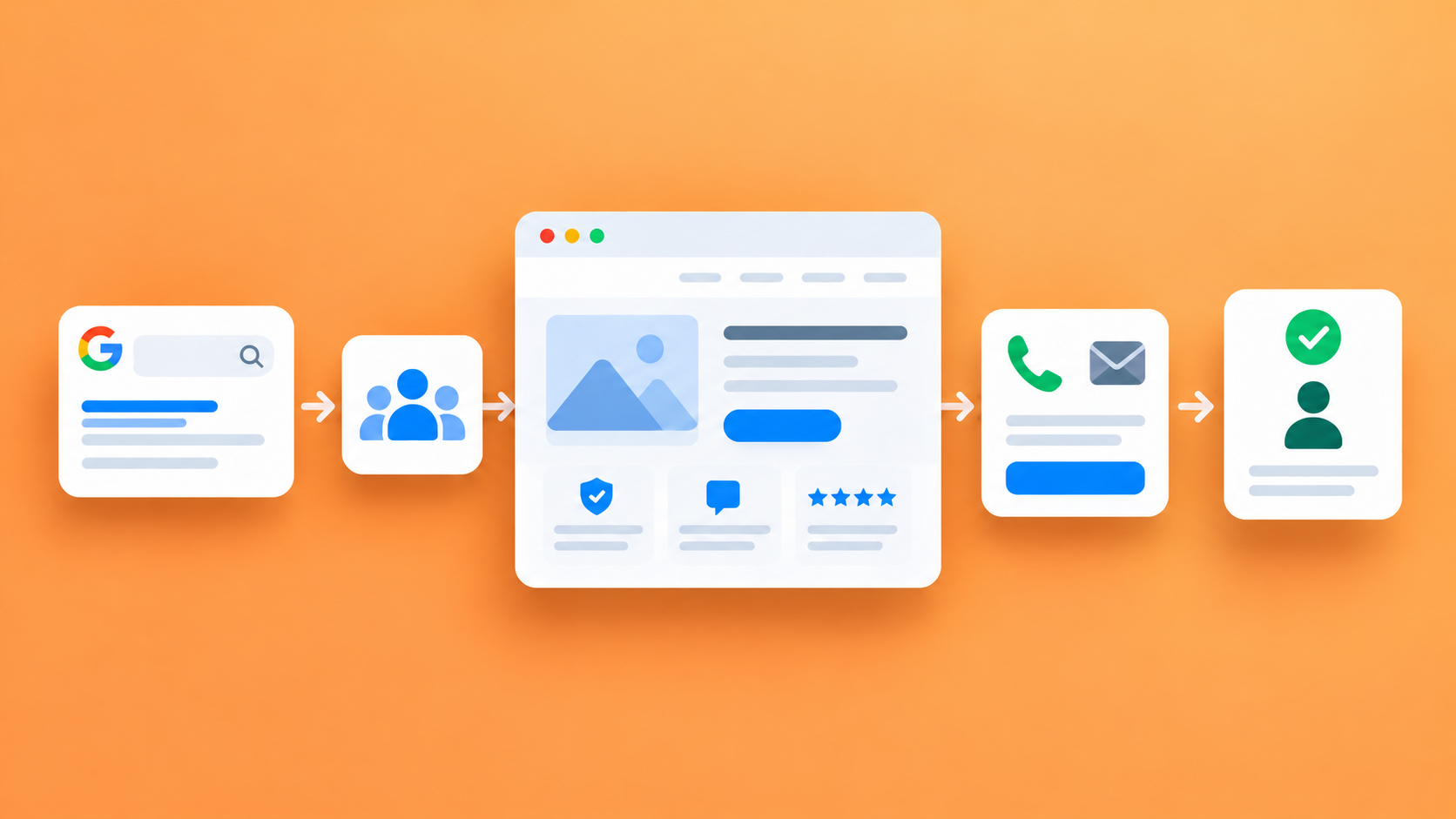
Likewise, a ChatGPT citation is not a referral visit. A referral visit is not necessarily a completed call or booking. And a completed inquiry only becomes a qualified lead when the business confirms that the customer and request are a good fit.
If you want to assess business results, keep these different records separate. Our guide to website traffic that isn't turning into leads can help when visitors arrive but few people contact you.
What should you do first?
Begin with one important service and one real customer question. Check the facts, confirm that your intended public information is accessible, inspect what a search-backed answer actually shows, and complete the worksheet. Then make the smallest justified improvement, or record that the evidence doesn't yet support a change.
The goal is not to manufacture a mention. It is to make the business easier for real customers to understand and to respond sensibly when public information is wrong or incomplete.