How Trade and Home Service Businesses Can Use AI to Get Found Online
Use AI to improve your SEO, service pages, local visibility and customer enquiries. Includes practical prompts, examples and a 30-day action plan.
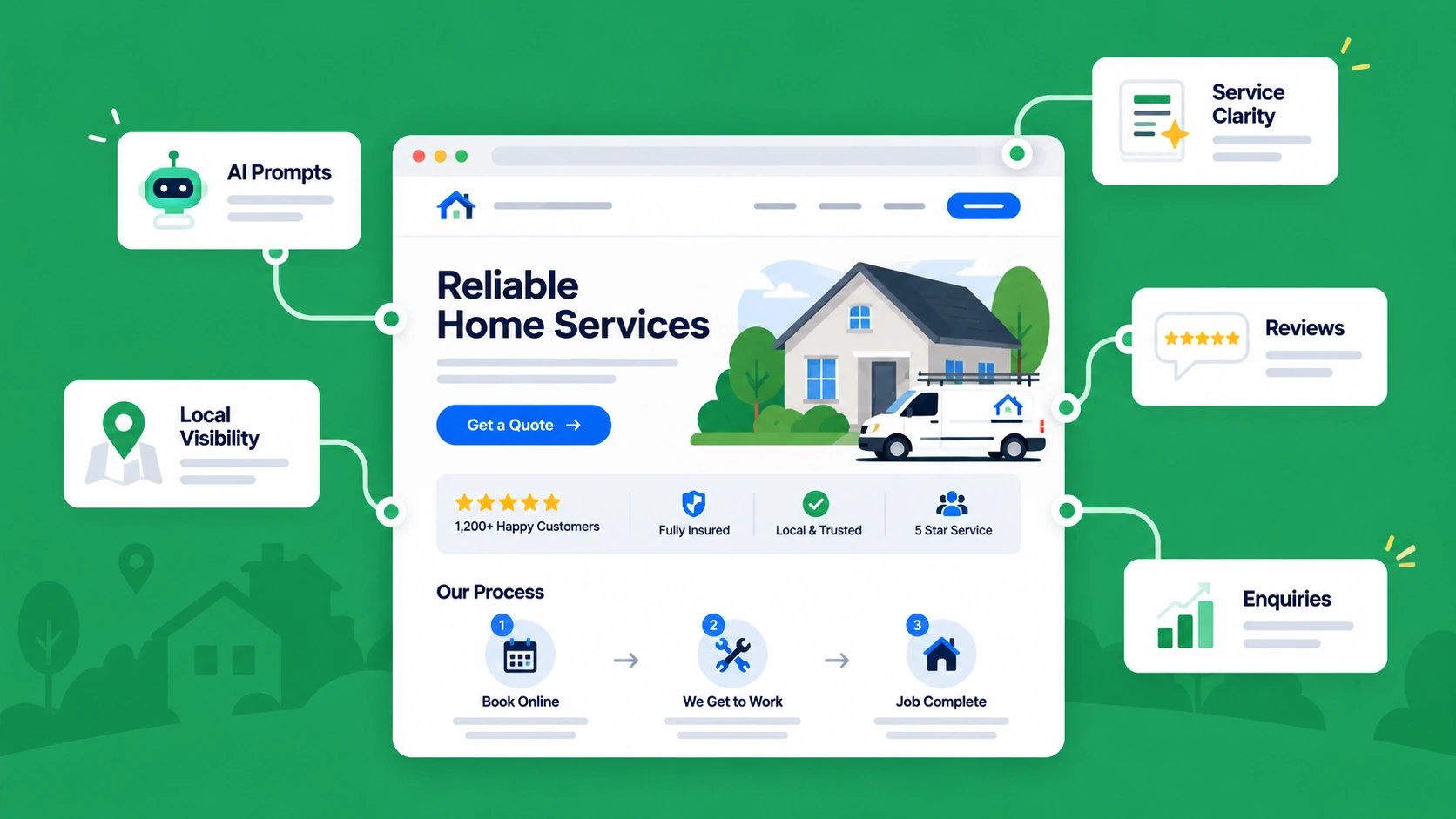
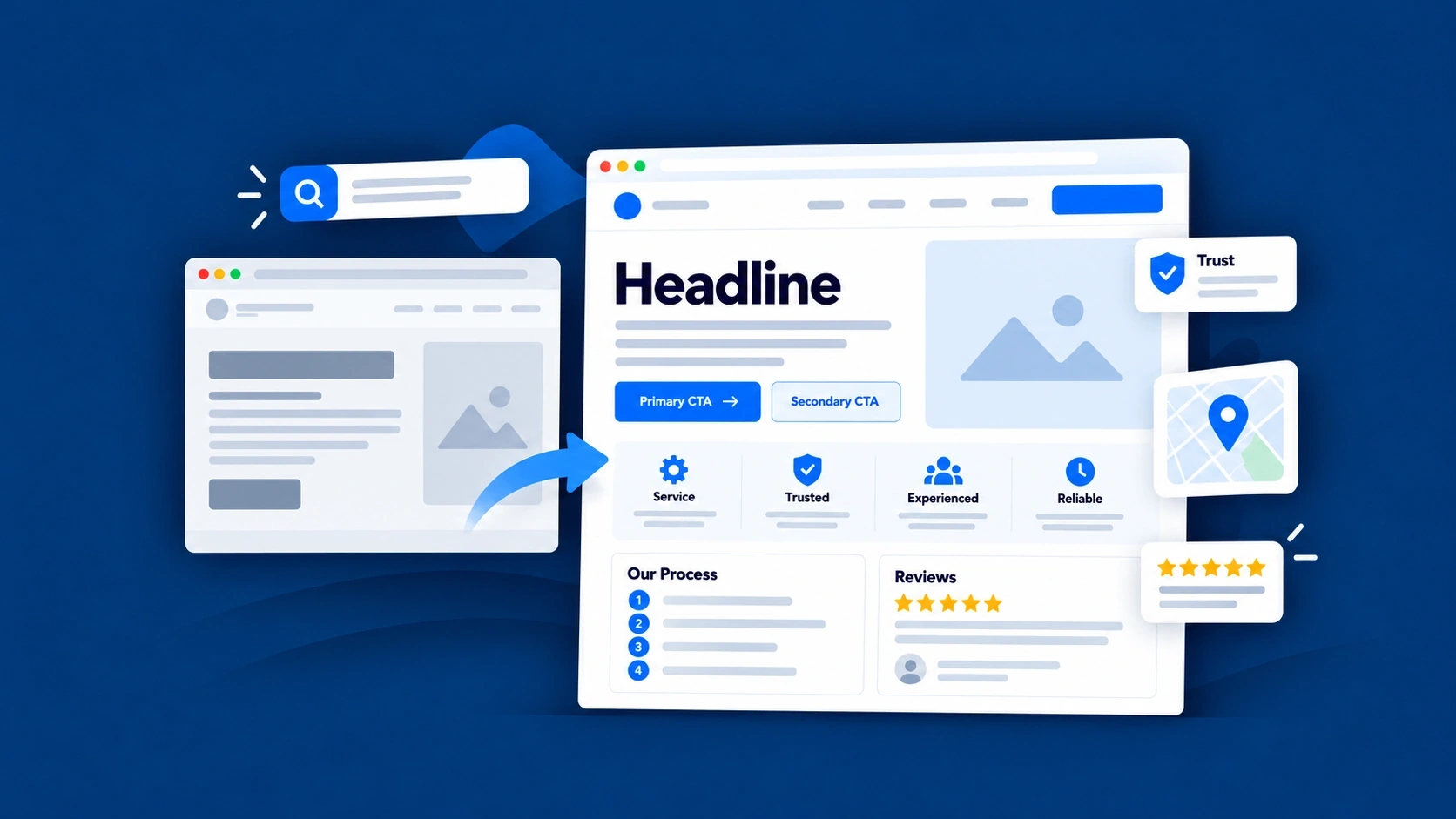
Conceptual website illustration with fictional business details.
In this guide14 sections
- 01Two AI opportunities
- 02How customers search
- 03Give AI the right context
- 04Website checklist & example
- 05AI search foundations
- 06Three business examples
- 0712 practical AI prompts
- 08Time-saving uses beyond SEO
- 09Measure meaningful progress
- 10Your first 30 days
- 11Mistakes to avoid
- 12Connect the work with a plan
- 13Frequently asked questions
- 14Make your business easier to choose
A practical guide to ChatGPT, AI search, local SEO, better websites, and winning more customer enquiries, with 12 prompts you can start using today.
Imagine someone needs a plumber.
A few years ago, they might have opened Google and searched for "plumber near me."
Today, they might still do that. But they could also open ChatGPT and ask:
Can you recommend a reliable plumber near me who handles blocked drains?
Or they might ask Claude which local roofing companies are worth considering, or use Google's AI search features to compare different service providers.
The way people discover businesses is changing.
And if you run a plumbing company, electrical business, roofing service, HVAC company, cleaning business, or another trade or home service business, that change deserves your attention.
But there's another opportunity that could be just as valuable.
You can use AI yourself to improve how your business appears online, explain your services more clearly, answer customer questions, and make it easier for people to contact you.
You don't need to become an AI expert.
You don't need to learn programming.
And you certainly don't need to publish fifty AI-generated articles every month.
You need to know which tasks are worth doing, what information to give AI, and how to turn its suggestions into useful website improvements.
In this guide, we'll explore both sides of the opportunity:
- How to use AI tools such as ChatGPT and Claude to improve your online presence.
- How to make your business easier to discover, understand, and evaluate when people search through Google and AI-powered tools.
You'll also get 12 practical prompts, real-world-style examples, and a 30-day improvement plan.
Whether you're a tradie in Australia, a contractor in the United States, or a tradesperson in the United Kingdom, you can adapt the advice to your own services and location.
Quick Overview
Here are the most important things to understand:
- AI can help you review and improve your website. Use it to identify unclear service descriptions, missing information, weak calls to action, and unanswered customer questions.
- Your services and service areas need to be accurate. Explain what you actually do, where you work, and how customers can get in touch.
- Google and AI search are related, but not identical. Good SEO foundations can support discoverability, but there is no reliable prompt that forces ChatGPT, Claude, or Google AI to recommend your business.
- Your experience is valuable content. Real projects, practical explanations, original photographs, and genuine customer feedback can help your business stand out from generic AI-generated websites.
- A useful service page may matter more than another blog post. Help people who already need your services before spending heavily on content volume.
- You can make progress without doing everything at once. Start with your most important service, improve its page, review your business listings, and measure what happens.
The goal isn't simply to get more visitors.
It's to help the right customers find your business, understand what you offer, trust your experience, and take the next step.
1. AI Creates Two Different Opportunities for Trade Businesses
It's useful to separate two ideas that often get mixed together.
Using AI to improve your marketing is different from being discovered through AI-powered search.
Both matter, but they require different actions.
Use AI in your business
Get help researching, planning, writing, reviewing, and organizing marketing work
Ask ChatGPT to review your electrical services page and identify missing information
Be discoverable through AI search
Help search systems access reliable information about your business when answering relevant questions
Make your real plumbing services, locations, qualifications, and contact details easy to find and verify
The first opportunity is something you can start working on today.
You can ask AI to review your website, help improve the wording, prepare customer FAQs, or organize a simple marketing plan.
The second opportunity involves how external platforms discover and select information.
You can improve the information available to those systems, but you cannot control which businesses they recommend.
Understanding that distinction will save you time and help you avoid misleading promises about AI SEO.
2. How Customers Find Trade Businesses Through Google and AI
Let's look at three ways someone might search.
Traditional Google Search
A homeowner in Melbourne searches:
Blocked drain plumber Melbourne.
Google may show advertisements, local business listings, and organic website results.
The search is closely connected to a specific service and location.
A useful plumbing service page and an accurate Google Business Profile can help people understand whether a company is relevant.
Google AI features
A homeowner in Dallas might ask a more detailed question:
My air conditioner isn't cooling properly. What should I check, and when should I call an HVAC contractor?
Google's AI features may provide an explanation and links to relevant sources.
A useful HVAC article explaining common causes and appropriate next steps could be relevant to that informational need.
A clearly written service page could help someone who's ready to hire a contractor.
Google's official guidance on generative AI search confirms that established SEO best practices remain foundational for its AI search features.
ChatGPT and Claude
Someone could ask ChatGPT:
Find a residential electrician serving my area who handles electrical panel upgrades.
Or ask Claude:
What should I look for when comparing roofing contractors in my city?
When these tools use web search, they can consult online information and provide links or citations to sources.
ChatGPT Search and Claude's web search do not necessarily use the same retrieval processes or select the same information.
And recommendations may differ depending on the question, available sources, location context, and when the search happens.
There is no permanent number-one position in ChatGPT or Claude that you can secure by adding a particular phrase to your website.
The practical opportunity is to improve the quality, accuracy, accessibility, and usefulness of the information available about your business.
3. Before You Use AI, Give It the Right Information About Your Business
Here's one of the simplest ways to get better results from AI.
Don't begin with:
Write SEO content for my electrical business.
AI doesn't yet know what your business offers, who your customers are, where you work, or why someone should choose you.
It may produce polished writing that could belong to almost any electrician.
Instead, start with a basic business information sheet.
Your AI business brief
| Information | What to provide |
|---|---|
| Business type | Plumber, electrician, roofer, HVAC contractor, cleaner, or another service |
| Main services | The services you actually offer |
| Most valuable work | The jobs or service types you want more of |
| Customers | Residential, commercial, property managers, builders, or other audiences |
| Locations | Your real service areas or offices |
| Experience and proof | Verifiable qualifications, relevant experience, project examples, and reviews |
| Customer questions | What people ask before requesting a quote or booking |
| Enquiry method | Phone, form, online booking, or consultation |
| Limitations | Services you don't offer, areas you don't cover, and promises you cannot make |
You can keep this in a document and reuse it whenever you ask AI for marketing help.
For example, an electrician in Melbourne might explain that the business mainly wants switchboard upgrade work, covers selected eastern suburbs, and prefers customers to submit a short quote request.
An HVAC contractor in Dallas might prioritize air conditioning replacements and scheduled maintenance, while avoiding services the company doesn't provide.
The useful AI recommendations will be different.
One rule that matters
Never allow AI to invent business facts.
If you haven't provided information about a license, certification, guarantee, price, office, project, or service area, the AI shouldn't make one up.
And avoid putting customers' personal information, private addresses, security details, or confidential job records into public AI tools without appropriate permission and safeguards.
Use anonymized examples when possible.
4. What Every Good Trade Business Website Should Have
Before spending money on new articles or advanced AI SEO techniques, review your existing website.
A potential customer often wants straightforward answers.
Do you provide the service I need?
Do you work in my area?
Can I trust you?
How do I get a quote?
If those answers are difficult to find, attracting more website visitors may not solve the problem.
The practical website checklist
Not every website needs the same number of pages or sections.
A business offering one focused service may need less content than a company providing ten different services across several locations.
The important thing is that the information matches what the business actually does.
A practical example: A plumbing service page
Imagine a fictional plumbing company in Melbourne.
Its existing service page opens with:
Quality Plumbing Solutions
We provide professional plumbing services with a commitment to quality, reliability, and customer satisfaction.
That sounds respectable, but it's vague.
Now imagine the company genuinely provides blocked drain clearing.
A more useful opening could be:
Blocked Drain Clearing in Melbourne
Dealing with a slow-draining sink, recurring blockage, or blocked household drain?
We help homeowners across our selected Melbourne service areas investigate and address common residential drainage problems.
Tell us what's happening and where the property is located. We'll confirm whether the job is within our service scope and explain how to arrange the next step.
Request a Drain Assessment | Call Us
The second version is more specific.
It identifies the service, explains the type of problem, mentions genuine geographic coverage, and makes the next step clear.
It doesn't need to repeat the phrase "blocked drain plumber Melbourne" in every paragraph.
It needs to help the customer.
For a detailed walkthrough of this approach, see our guide to writing a service page that attracts the right customers.
5. How to Make Your Business Easier to Find Through AI Search
This is probably the part of AI marketing that creates the most curiosity.
Business owners want to know:
How do I get ChatGPT to recommend my business?
It's a reasonable question.
But the best place to begin isn't a trick designed to influence ChatGPT.
It's making sure the business has accurate, useful information available online.
Start with five foundations
1. Explain your services clearly.
A page about electrical panel upgrades should actually explain electrical panel upgrades.
A roofing page should describe the work provided, who it's for, the process, and important limitations.
Generic text makes it harder for anyone to understand what makes the service relevant.
2. Make your real service locations clear.
If your plumbing business serves Melbourne and selected nearby suburbs, explain that naturally.
If you're an HVAC contractor serving Dallas and certain surrounding communities, accurately describe that coverage.
Don't create location pages for places where you don't genuinely work.
3. Show verifiable experience.
Real projects, original photographs, relevant credentials, and clear descriptions of completed work can help prospective customers understand your experience.
A genuine roof replacement project is more useful evidence than twenty generic statements about quality.
4. Keep important business information consistent.
Your website, eligible business listings, and relevant public profiles should accurately reflect your business.
Check important details such as your business name, contact information, service categories, locations, and operating arrangements.
5. Make the website accessible.
Your important public pages should be crawlable, indexable where intended, and easy to navigate.
Search engines and AI services cannot reliably work with information they cannot access.
Google Business Profile still matters
For eligible local businesses, an accurate Google Business Profile remains important.
Google states that local results are mainly influenced by relevance, distance, and prominence.
It also encourages complete and accurate business information, genuine reviews, and appropriate business details.
See Google's local ranking guidance.
For a plumber or cleaning company that travels to customers, the correct profile configuration may be a service-area business.
That doesn't mean creating a separate Google Business Profile for every city or suburb.
If the company doesn't receive customers at its business address, Google's service-area rules generally require that address to be hidden.
For businesses in markets where it's available, Bing Places for Business can also help maintain accurate business information in Bing's local search results.
The purpose of these profiles is to represent your real business, not to manufacture extra local locations.
What about getting ChatGPT and Claude to access your website?
This is a more technical check, but it's useful to understand.
OpenAI explains that OAI-SearchBot is used for ChatGPT search discovery. Public websites that want their content considered for summaries and citations should avoid accidentally blocking that crawler.
Anthropic identifies Claude-SearchBot for search-related discovery and Claude-User for some user-initiated website access.
These are different from crawlers used for model training.
You can read the official explanations:
If your website uses aggressive bot blocking, ask your website manager to check whether public pages are unnecessarily blocked.
Don't change security settings indiscriminately, and don't assume allowing a crawler guarantees recommendations.
Do you need special AI schema or an llms.txt file?
For Google's AI search features, the answer is no.
Google's 2026 guidance explicitly says that special AI markup, AI-specific text files, and other supposed shortcuts aren't required.
Appropriate structured data can still be useful for communicating legitimate business information and supporting eligible search features.
But marking up a business doesn't guarantee that AI systems will recommend it.
Get the fundamentals right before paying for advanced AI optimization techniques.
6. Three Practical Examples Across Different Markets
Let's see how these principles apply to different businesses.
Example A: An electrician in Australia
A Melbourne electrician provides several services, but wants more enquiries for switchboard upgrades.
The website mentions switchboard work only briefly on the homepage.
Possible priority: Improve or create the relevant service page, confirm the actual service areas, explain the work and assessment process, and add appropriate verifiable qualifications.
AI could help review the current page and prepare a clearer draft.
A qualified person must still check any electrical safety statements, licensing details, and technical claims.
The business doesn't automatically need ten new articles.
Example B: An HVAC contractor in the United States
A fictional HVAC company in Dallas already has reasonable service pages, but little useful information explaining common maintenance concerns.
Customers frequently ask what to check when an air conditioner isn't cooling properly.
Possible priority: Create a practical supporting guide that explains appropriate homeowner checks, when professional assistance is needed, and how to contact the company.
AI could help organize the questions and prepare an outline.
The contractor should verify all technical and safety guidance before publication.
The article can then link naturally to the company's existing repair service.
Example C: A roofing business in the United Kingdom
A roofing company in Bristol has a clear website but very little evidence of the work it has completed.
The team has photographs from past projects, but rarely uses them online.
Possible priority: Build useful project examples showing the type of roof, the problem, the work completed, and relevant photographs.
AI can help turn verified project notes into readable descriptions and meaningful image captions.
The business should obtain any necessary permissions and avoid publishing customer-identifying details.
All three businesses could use AI.
But each should use it for a different priority.
That's why website review should come before content volume.
7. The Practical AI Prompt Toolkit for Trade and Home Service Businesses
This is where you can start putting the advice into practice.
The following 12 prompts are designed to work with ChatGPT, Claude, or another capable AI assistant.
You don't need to use all of them.
Choose the one that matches what your business needs.
Before using the prompts: Create your business context
Copy this into your AI conversation first, then complete the brackets.
Your reusable business brief
I'm using AI to improve the online presence of my trade or home service business.
Business type: [Business type]
Country and state/region: [Location]
Main services: [Services]
Services I want more work from: [Priorities]
Actual service areas: [Locations]
Ideal customers: [Customer types]
Relevant experience, qualifications, and proof: [Verified details]
Preferred enquiry method: [Phone, quote form, booking]
Website: [URL]
When helping me, use clear language my customers understand. Do not invent services, qualifications, licenses, reviews, guarantees, prices, service areas, or business facts. Identify missing information and ask questions when necessary. Prioritize useful improvements rather than creating content simply for volume.
You can reuse that information for the following prompts.
Prompt 1: Find out what your website needs most
Best for: Business owners unsure where to begin.
Review my website as a potential customer and an SEO adviser.
Website: [URL]
Focus on the services and customers described in my business brief.
Assess how clearly the website explains my services, geographic coverage, experience, customer process, and contact options.
Identify the five most important potential improvements. For each, explain the customer problem, the proposed improvement, and why it deserves attention.
Prioritize creating or improving necessary pages over generating unrelated articles.
If you cannot access the website, tell me and ask me to paste the relevant page content. Clearly distinguish what you verified from what you're assuming.
Why this is useful: It helps turn a broad request for SEO advice into an initial list of practical priorities.
Prompt 2: Improve an existing service page
Best for: Important services that are poorly explained.
Help me improve this service page: [Paste existing text]
Main service: [Service]
Intended customer: [Customer]
Actual service area: [Location]
Review the content for clarity, completeness, trust, and ease of enquiry.
First, identify what's missing or unclear.
Then propose a stronger structure with a useful headline, introduction, service details, process, trust information, FAQs, and calls to action.
Only rewrite the page using verified facts I supply. Put placeholders where important information is missing, and ask me questions before finalizing.
Why this is useful: It focuses AI on improving a page that already matters to the business.
Prompt 3: Turn common customer questions into useful content
Best for: Discovering relevant topics without guessing.
Here are questions customers commonly ask before booking our services:
[Insert anonymized questions]
Group them by service and customer need.
For each question, tell me whether the answer belongs on an existing service page, in a short FAQ, or in a separate supporting article.
Explain your decision.
Identify the five most useful content opportunities, considering customer value and our business priorities.
Avoid suggesting a new article when an existing page could answer the question better.
Why this is useful: Customer conversations are often a better starting point than generating random blog titles.
Prompt 4: Improve your Google Business Profile description
Best for: Making eligible business listings clearer and more accurate.
Help me write a clear Google Business Profile description for my business.
Use the services, experience, and service areas in my verified business brief.
Focus on what the business provides and who it helps.
Keep the language natural and factual.
Do not insert promotional offers, URLs, keyword lists, unsupported claims, or locations we don't genuinely serve.
Provide one concise description and explain which business facts I should double-check before publishing.
Why this is useful: A clear description can help customers understand what your business actually offers.
Remember that a description doesn't guarantee local rankings, and you should follow the platform's current business-information rules.
Prompt 5: Decide whether you need location pages
Best for: Businesses serving several cities, suburbs, or towns.
My business serves these locations: [Locations].
My important services are: [Services].
My current website pages are: [URLs or page list].
Help me decide whether I need dedicated location pages.
Separate locations that may justify useful individual pages from locations that could be explained on a general service-area page.
For each proposed new page, identify the distinct customer need and real local information required.
Don't recommend pages that would differ only by replacing one city name with another.
Why this is useful: It reduces the risk of spending money on unnecessary or repetitive city pages.
For a deeper explanation, see our guide to targeting multiple cities for SEO.
Prompt 6: Turn a real completed project into website content
Best for: Showing genuine experience.
Help me create a website project example using these verified details:
Service: [Service]
General location: [Area, without private customer details]
Customer problem: [Problem]
Work completed: [Actual work]
Relevant equipment or materials: [Verified details]
Outcome: [Verified result]
Approved photographs: [Descriptions]
Create a concise project summary explaining the problem, the work, and the outcome.
Suggest a useful headline, photo captions, and links to relevant service information.
Do not invent customer testimonials, savings, safety claims, or results.
Why this is useful: Real work can provide more compelling business-specific information than generic articles.
Prompt 7: Improve your website photographs
Best for: Getting more value from approved project images.
I'm adding photographs of our completed work to a website.
Here are the images and what they actually show: [Descriptions or images].
Suggest clear captions and concise alternative text where alternative text would be useful for accessibility.
Describe visible, relevant information without keyword stuffing.
Identify which photographs would benefit from explanatory text about the work.
Do not claim the images show things that aren't visible or verified.
Why this is useful: Photographs can help customers understand your services, while clear captions and appropriate alternative text improve the page's usefulness.
Prompt 8: Make it easier for customers to contact your business
Best for: Websites getting visits but too few enquiries.
Review the following service page and contact process from the perspective of someone who wants to hire us.
Page content: [Paste]
Contact form fields: [List]
Booking or phone options: [Describe]
Identify anything confusing, unnecessary, or difficult to use, especially on mobile.
Recommend improvements to the primary call to action, form, contact information, and explanation of what happens after an enquiry.
Prioritize the three most useful changes.
Do not assume the form is broken or that customers are abandoning it without evidence.
Why this is useful: Sometimes the most valuable website improvement isn't attracting more visitors. It's removing barriers for visitors who are already interested.
Prompt 9: Ask customers for genuine reviews
Best for: Preparing neutral review requests and responses.
Draft a short, friendly review request I can send to customers after completing a job.
Business: [Business]
Channel: [Email or message]
Include a placeholder for our official review link.
Invite honest feedback without requesting a particular star rating or positive review.
Don't offer discounts, gifts, or other incentives.
Also provide one polite example response to a positive review and one to a negative review, without inventing details or revealing private customer information.
Why this is useful: Genuine reviews can help potential customers evaluate a local business.
Google prohibits paid or incentivized reviews and selective requests designed to obtain only positive feedback. See its review guidance.
Prompt 10: Check what AI search systems can actually find
Best for: Investigating AI visibility without relying on guesses.
Use web search, if available, to investigate public information about this business:
Business name: [Name]
Website: [URL]
Services: [Services]
Actual location and service areas: [Locations]
Search for the business and relevant service information using public web sources.
Report which facts you can verify, which sources support them, where information is missing or inconsistent, and any accessibility issues you encounter.
Separate verified findings from assumptions.
Cite the sources.
Do not claim my business has a particular ChatGPT, Claude, or Google AI ranking. If you cannot browse the web, state that limitation rather than guessing.
Why this is useful: It can reveal missing or inconsistent public information, although it isn't a definitive AI visibility audit.
Prompt 11: Build a sensible monthly website improvement plan
Best for: Turning scattered ideas into manageable priorities.
Using my business brief and the website problems we've identified, prepare a practical four-week website improvement plan.
Prioritize tasks according to their likely customer value, available evidence, business importance, and effort.
Separate tasks into:
- Work I can do myself.
- Work AI can help me prepare.
- Work that requires a developer or specialist.
Recommend no more than two significant priorities per week.
Explain why the order makes sense.
Don't automatically recommend new articles if existing pages need improving first.
Why this is useful: It turns SEO from a disconnected to-do list into a manageable sequence of work.
Prompt 12: Understand what your website reports really mean
Best for: Business owners using Search Console or Analytics.
Help me understand these website performance figures:
[Paste relevant data or upload a report]
Explain what the numbers mean in plain English.
Separate search impressions, clicks, website visits, contact interactions, confirmed enquiries, and qualified leads.
Identify useful trends, limitations, and missing information.
Don't treat a phone-link click as a completed call or a form interaction as a confirmed customer.
Don't claim that an SEO change caused an improvement unless the evidence supports that conclusion.
Recommend three sensible questions to investigate next.
Why this is useful: It helps you make decisions based on what the numbers actually represent.
8. Five Quick AI Uses That Can Save Time Beyond SEO
AI doesn't need to be limited to your website.
Once you have accurate business information, there are several everyday tasks where it may help.
| Task | How AI can help | What you must check |
|---|---|---|
| Quote follow-ups | Prepare a friendly message asking whether a customer needs more information | Pricing, job details, timing, and the customer's actual circumstances |
| Appointment confirmations | Draft clear instructions about access, preparation, and what happens next | Real booking details and company procedures |
| Customer FAQs | Turn repetitive questions into concise explanations | Technical accuracy and business policies |
| Project summaries | Organize notes into useful records or marketing descriptions | Accuracy, privacy, and permission to share details |
| Seasonal reminders | Prepare relevant maintenance information for customers | Technical safety, genuine service availability, and applicable marketing rules |
These tasks may not directly improve search rankings.
But they can help the business communicate more clearly and consistently.
For example, an HVAC business could use AI to draft a seasonal maintenance reminder based on advice checked by its technicians.
A roofing company could prepare a follow-up email explaining how to request an inspection.
And a cleaning business could improve the instructions it sends customers before an appointment.
The rule remains the same: AI helps prepare the information, while the business verifies and approves it.
9. How to Know Whether Your AI and SEO Improvements Are Working
One of the easiest mistakes is to measure success using only website traffic.
Traffic matters, but it doesn't tell the whole story.
A website might attract many visitors who aren't looking to hire someone.
Another website might attract fewer visitors but receive more relevant enquiries.
You need to understand the difference.
The measurements worth separating
| Measure | Where to look | What it tells you |
|---|---|---|
| Google search impressions | Search Console | How often your pages appeared in eligible Google search results |
| Google search clicks | Search Console | Recorded clicks from Google Search |
| Google AI search visibility | Search Console's Generative AI performance reports, when available | Which pages received reported impressions in Google's generative AI features |
| Website visits | Configured website analytics | How people reached and used your website |
| Contact interactions | Configured events | Actions such as phone-link clicks or form interactions |
| Confirmed enquiries | Form submissions, call records, booking systems, or CRM | Enquiries the business actually received |
| Qualified leads | Business records | Enquiries that fit your services and customers |
| Completed jobs | Job management or sales records | Work that turned into paying customers |
In 2026, Google introduced dedicated generative AI performance reporting within Search Console. These reports can show visibility in Google AI search features, including impressions, pages, and geographic breakdowns. They are not the same as a complete report of recommendations from every AI platform.
See Google's announcement about Generative AI performance reports.
A simple worked example
Imagine your website records the following activity in one month.
- Visits from organic search
- 400
- Phone-link clicks
- 24
- Confirmed enquiries received
- 12
- Enquiries matching the services and locations you want
- 8
- Completed jobs associated with those enquiries
- 3
These numbers are fictional and for illustration only, not expected industry conversion rates.
Notice that the 24 phone-link clicks don't mean 24 phone calls took place.
And the 12 confirmed enquiries aren't automatically twelve suitable customers.
If the website is generating plenty of traffic but few relevant enquiries, you may need to investigate search intent, service-page clarity, trust, and contact usability.
If a page receives very little relevant search visibility, improving its search relevance may deserve attention.
The right action depends on the problem.
Our guide to website traffic but no leads explains how to work through those situations in more detail.
A useful AI search test
You can also periodically ask web-enabled tools about services in your area and examine the sources they use.
For example:
Which companies provide roof repairs in Bristol, and what information is available about their experience and service areas?
Record the date, prompt, location context, tool, and cited sources.
But be careful about interpreting the result.
One answer doesn't establish a stable ranking.
The tool may return different businesses another day or for a differently worded question.
Use those tests to understand what public information is discoverable and potentially missing, not as proof of guaranteed market visibility.
10. Your First 30 Days Using AI to Improve Your Online Presence
You don't need to complete everything in this guide immediately.
A practical month could involve four focused stages.
Week 1: Understand what your website needs
Your objective: Identify the most important gaps.
- Complete your reusable AI business brief.
- Review your homepage and important service pages.
- Check your actual service-area information.
- Use Prompt 1 to identify possible improvements.
- Verify the findings yourself.
Your deliverable: A short prioritized list of website changes.
Week 2: Improve one important service page
Your objective: Make a commercially relevant page more useful.
- Choose a service you genuinely want more enquiries for.
- Gather verified service information.
- Use Prompt 2 to prepare clearer content.
- Explain the service process and next step.
- Review and publish the approved improvement.
Your deliverable: One stronger service page.
Week 3: Improve trust and local information
Your objective: Help customers verify and evaluate your business.
- Review your eligible business profiles.
- Check that your service areas are accurate.
- Add useful original project photographs where available.
- Prepare one genuine project example.
- Review the mobile contact experience.
- Ask recent customers for honest feedback where appropriate.
Your deliverable: Clearer business information and better supporting evidence.
Week 4: Measure and choose the next improvement
Your objective: Avoid returning to random marketing activity.
- Review available Search Console information.
- Check actual customer enquiries.
- Look at any configured analytics events.
- Investigate whether an important customer question needs answering.
- Use Prompt 11 to prepare your next monthly plan.
Your deliverable: A practical next-step plan based on evidence and completed work.
What should happen after the 30 days?
You repeat the process with updated priorities.
Perhaps another service page needs improvement.
Maybe your Google Business Profile needs more complete information.
Perhaps a useful supporting article has a clear purpose.
Or maybe you need professional assistance with a technical website issue.
Good ongoing SEO isn't about doing the same tasks every month. It's about deciding what still needs attention and making useful improvements over time.
11. AI SEO Mistakes Trade Businesses Should Avoid
AI can save time, but it can also make poor decisions faster.
These are some of the mistakes worth avoiding.
Publishing AI-generated content without reviewing it
AI may invent services, prices, qualifications, warranties, or technical advice.
That can be particularly problematic for electrical, plumbing, gas, roofing, and other work involving safety or regulated activities.
Always verify important claims.
Creating a page for every city or suburb
A contractor serving multiple areas doesn't automatically need dozens of near-identical location pages.
Explain your genuine service coverage first.
Create separate pages only when they provide distinct, useful information.
Inventing local offices
A service-area business should not create fake office addresses to appear in more local searches.
Use accurate business information and follow the relevant listing platform's eligibility rules.
Using fake project photographs or testimonials
AI-generated images can be useful for illustrating general concepts.
But they shouldn't be presented as photographs of jobs your business actually completed.
Likewise, AI shouldn't invent customer reviews or outcomes.
Paying for guaranteed AI recommendations
Be cautious about services promising that ChatGPT, Claude, or Google AI will recommend your business in a particular position.
There is no reliable universal method to guarantee that outcome.
Publishing content just to satisfy a monthly quota
A website with weak service pages doesn't necessarily benefit from publishing another twenty articles.
Fixing one important page may be more valuable than creating a large amount of disconnected content.
Ignoring the actual customer experience
SEO and AI discovery matter, but so does what happens when a visitor reaches your website.
If your phone number is difficult to find or your quote form doesn't work properly, attracting more visitors may only increase wasted opportunities.
12. When Does It Make Sense to Use a Strategy-Led SEO Platform?
By now, you've seen that AI can help with a substantial amount of website and marketing work.
You can review pages, draft descriptions, organize customer questions, plan improvements, and prepare useful content.
But there's still a challenge.
Someone needs to decide what the website needs, organize the work, keep the information consistent, and make sure the right improvements actually get completed.
For a busy contractor, that can become another ongoing responsibility.
You might improve your homepage this month, then become busy with jobs and forget about the next round of website work.
Or you might generate useful ideas with ChatGPT but never find the time to implement them.
This is the problem Blue Kite SEO is designed to address.
How Blue Kite SEO works
Rather than beginning with a request to generate articles, the platform starts by learning about your business.
1. Business Profile
You provide information about your services, customers, locations, and priorities.
2. Website Review
Blue Kite SEO reviews the website information it can access and identifies potential gaps, overlap, and opportunities.
3. SEO Strategy
It prepares a plain-English SEO Strategy explaining what deserves attention and why. You can review the direction and request available changes.
4. Monthly SEO Plan
The Strategy becomes the foundation for an ongoing plan that prioritizes the next useful work.
5. Create, Review, and Publish
Blue Kite SEO prepares supported pages, articles, and website improvements for your review.
With a compatible connected WordPress website, the platform can also carry out supported publishing and selected website updates with your approval.
For other platforms, it can prepare content and relevant instructions for you or your website manager.
The difference from using ChatGPT alone
ChatGPT and Claude can be valuable assistants.
But you still need to provide the right context, identify what deserves attention, check the outputs, maintain a plan, and arrange implementation.
Blue Kite SEO is designed to connect those steps through a strategy-led ongoing workflow.
It's not a replacement for every service a traditional SEO agency or developer provides.
Complex technical problems, custom development, major migrations, or specialist digital PR may still require professional assistance.
But for trade and home service businesses that need a more organized way to manage ongoing SEO website work, it offers another option.
You can explore the full process in How Blue Kite SEO Works.
13. Frequently Asked Questions
Can AI really help a small plumbing or electrical business with SEO?
Yes. AI can help review website copy, organize service information, identify potential content gaps, prepare drafts, improve FAQs, and suggest next steps. The business still needs to verify all important facts and decide which work is genuinely useful.
How do I get ChatGPT to recommend my trade business?
There is no guaranteed recommendation formula. Focus on accurate public business information, useful service pages, genuine evidence, and accessible website content. Ensure your website isn't accidentally blocking relevant search crawlers, and review the sources AI tools can actually find.
Does my business need a blog to appear in AI search?
No. A blog isn't a universal requirement. Clear service pages, accurate business details, useful project information, and other relevant content can all matter. Create articles when they answer worthwhile customer questions that your existing pages don't already address.
Should I use AI to create a page for every suburb or city?
Not automatically. A genuine service area doesn't always need an individual page. Create location pages when they provide distinct, useful local information, rather than changing the city name across otherwise identical pages.
Can AI write my Google Business Profile description?
AI can help prepare a draft based on verified facts. You should still review it for accuracy and compliance with the platform's content rules. Don't add false locations, unsupported claims, or promotional information that doesn't belong in the description.
Can AI-generated content hurt my SEO?
AI-generated content isn't automatically bad for SEO. The greater concern is publishing inaccurate, repetitive, low-value, or misleading material, especially content created primarily to manipulate search visibility rather than help customers.
Do I need special AI schema to appear in Google's AI search features?
No. Google says special AI markup isn't required. Relevant structured data can support ordinary search features when used correctly, but it's not a guaranteed route into AI answers.
What if I don't have time to manage SEO myself?
You can start with a few focused improvements, hire specialists for particular problems, use AI for preparation, or choose a strategy-led platform to help organize ongoing work. The right approach depends on your website, business needs, available time, and budget.
The Bottom Line: Use AI to Make Your Business Easier to Find and Choose
AI gives trade and home service businesses a genuinely useful opportunity.
It can help you review your website, explain your services, organize customer questions, improve communications, and prepare work that might otherwise take much longer.
It can also change how potential customers discover businesses online.
But that doesn't mean every tradie or contractor needs a complicated AI strategy.
And it certainly doesn't mean publishing enormous amounts of AI-generated content.
Start with the fundamentals.
- Make your services clear.
- Explain where you genuinely work.
- Show real experience.
- Answer useful customer questions.
- Make contacting you straightforward.
And use AI to help identify and prepare improvements that serve those goals.
You don't need to become an AI expert. You need to use AI to make better decisions about your business's online presence.
That is where the technology becomes genuinely valuable.
Want Help Turning These Ideas Into Ongoing Website Improvements?
You can use the prompts in this guide yourself.
But if you'd rather have a platform that connects your business information, website review, SEO Strategy, monthly priorities, and supported website work, take a look at Blue Kite SEO.
It helps small service businesses identify what their websites need and prepare practical improvements for review and approval.
A clearer strategy. Better priorities. More of the right website work getting done.
Blue Kite SEO supports strategy-led SEO website work. It does not guarantee Google rankings, AI recommendations, website traffic, enquiries, or customers.