SEO for Physical Therapy Clinics: A Practical Guide to Getting Found and Helping Patients Book
An actionable guide for physical therapy and rehabilitation practices. Learn how to improve treatment pages, clinic locations, therapist profiles, local search visibility, and the path from an online search to a first appointment.
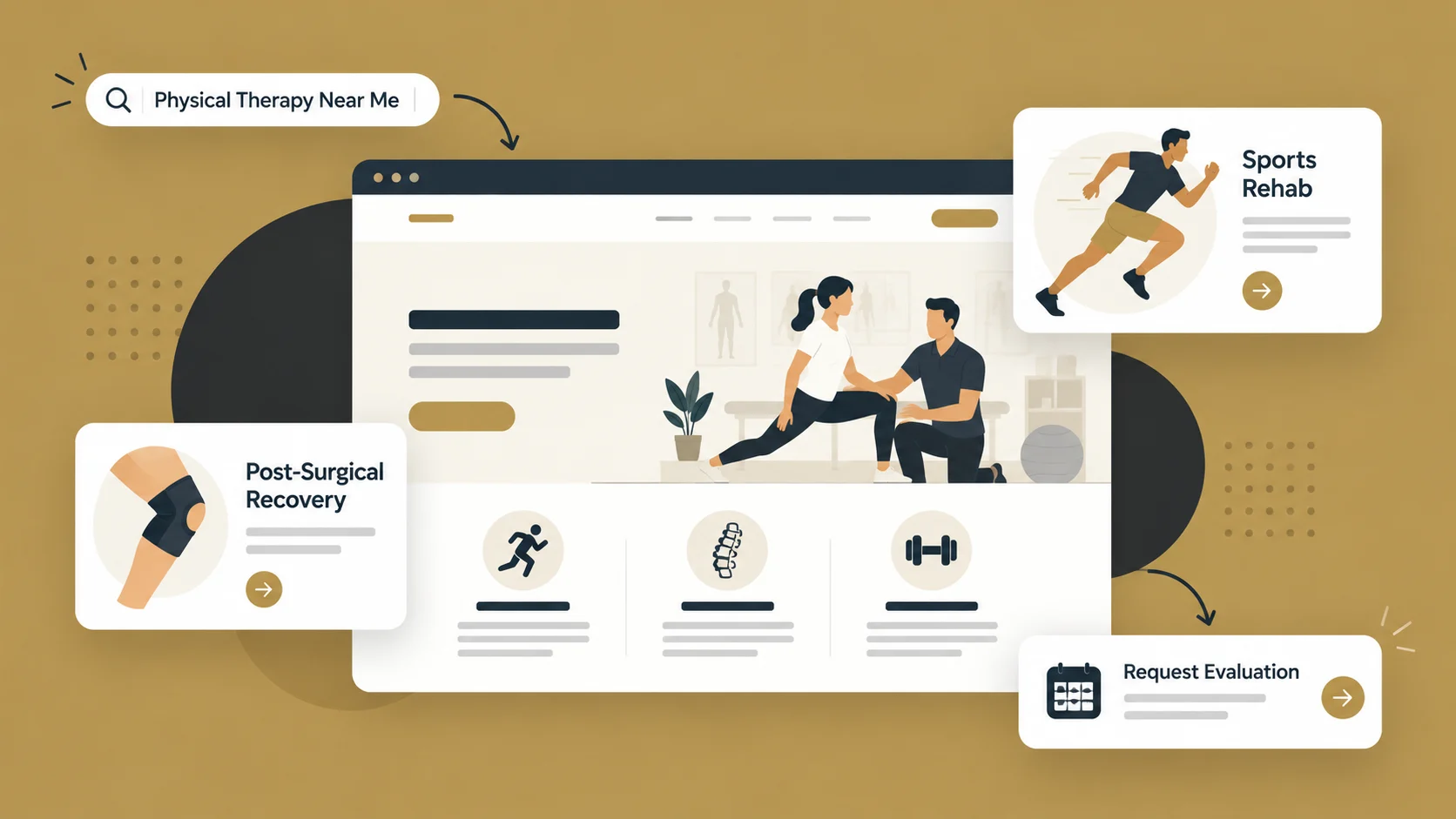
An illustrative physical-therapy website concept. The clinic, people, treatment scene and interface shown are fictional.
In this guide19 sections
- 01How patients search
- 02The clinic and its services
- 03Your website structure
- 04A stronger treatment page
- 05Useful clinic locations
- 06Google profiles and reviews
- 07Trustworthy therapist profiles
- 08Referrals, insurance and visits
- 09A safer booking journey
- 10Responsible health content
- 11Images and ethical proof
- 12Technical foundations
- 13AI-powered search
- 14Measure real appointment progress
- 15Your first 30 days
- 16Common mistakes
- 17Where Blue Kite SEO helps
- 18Frequently asked questions
- 19Your next useful improvement
A person searching for physical therapy may have a very specific goal: find someone who can help them after surgery.
Another may be comparing local clinics for a sports injury.
Someone else has been referred by a physician and just wants to know whether a clinic takes their insurance, has an appointment available, and is easy to get to.
They might search “physical therapy near me,” “post-surgical rehab Columbus,” or the name of a clinic recommended by a friend. They may also use Google's AI features or ask an AI assistant what to look for in a physical therapist.
Those searches may all lead to a physical therapy website, but the people behind them need different answers.
If your homepage says only “We help you feel your best,” visitors still have to work out what your clinic treats, who provides care, where to go, what their insurance questions mean, and how to arrange an appointment.
More search traffic won't necessarily solve that problem.
Useful SEO for a physical therapy clinic combines two things: making the right information discoverable and making it easier for the right person to take an appropriate next step. It is not about promising recovery, publishing hundreds of condition pages, or turning patient information into marketing data.
This guide follows a fictional outpatient clinic in Columbus, Ohio, through a complete website-improvement plan.
The primary examples use US terminology, but the principles are relevant to physiotherapy practices and rehabilitation clinics in Australia, the UK, Canada, and other markets when local rules are checked.
Quick Overview: What Should a Physical Therapy Clinic Work On First?
- Prioritize services your clinicians actually provide. A post-surgical rehabilitation page, sports physical therapy page, and general orthopedic PT page may serve different needs. Don't create pages merely because a keyword exists.
- Make each treatment page useful. Explain who the service may be relevant for, what an evaluation involves, where it is offered, and how someone can inquire. Avoid diagnoses or promises about individual outcomes.
- Build trustworthy clinician and clinic information. Show real therapist names, verified credentials, actual locations, and clear patient expectations.
- Treat local SEO as essential clinic information. Keep Google Business Profiles, hours, categories, contact details, and location pages accurate.
- Make insurance, referral, and scheduling information understandable. Coverage and direct-access rules vary. Patients should know what the clinic can confirm and what to ask before booking.
- Protect patient privacy. Use appropriate clinical review, consent, secure forms, and careful analytics configuration. Generic SEO tools cannot determine HIPAA compliance.
- Measure booking outcomes carefully. Organic clicks, booking-button clicks, confirmed requests, attended evaluations, and accepted patients are different measures.
The right SEO priority is the improvement that helps an appropriate prospective patient understand your service and safely contact your clinic.
1. Understand the Different Reasons People Search for Physical Therapy
A person typing “physical therapist near me” may be ready to compare clinics. Someone asking “what happens at a first physical therapy appointment?” may be preparing for a visit. A person looking for a named therapist may already have a referral.
These are not identical search intentions.
| Example search | Likely question behind it | Useful destination |
|---|---|---|
| physical therapy near me | Where can I find a suitable local clinic? | Clinic or location page, with services and booking details |
| sports physical therapy Columbus | Does a nearby clinic offer this type of care? | A real sports rehabilitation service page |
| physical therapy after knee surgery | What might postoperative rehabilitation involve? | Clinically reviewed explanation, connected to a relevant service page |
| does physical therapy need a referral | Can I request an evaluation directly? | Current, jurisdiction-aware access and insurance FAQ |
| [clinic name] physical therapy | Is this the clinic someone recommended? | Homepage, clinic photos, therapist profiles, hours, contact details |
| what to bring to first PT appointment | How do I prepare? | First-visit information with practical clinic instructions |
These phrases are illustrative examples, not verified search volumes or ranking opportunities. The best priorities come from your actual services, patient questions, website evidence, and local market.
Search visibility also supports referrals
Patients may hear about a clinic from a physician, another healthcare professional, a former patient, or a friend. They may then search for the clinic name, check its location and therapist profiles, or look up insurance details before contacting it.
That means a good website does not have to replace referrals. It can make a referral easier to verify and act on.
Try this: Write down five questions people routinely ask before scheduling. If your site doesn't answer them clearly, you may have a useful SEO and patient-experience improvement already waiting.
2. Start With What Your Clinic Actually Does
A small physical therapy practice should not optimize for every possible condition or rehabilitation specialty. Its pages need to reflect its actual scope, clinicians, capacity, and patient population.
Before creating a content plan, write a short clinic brief:
| Clinic information | What to record |
|---|---|
| Services | Outpatient orthopedic PT, postoperative rehabilitation, sports rehabilitation, balance therapy, or other services actually provided |
| Patient fit | Age groups, cases, and circumstances the clinic is equipped to assess and serve |
| Clinical team | Verified licenses, relevant qualifications, responsibilities, and actual services performed |
| Locations | Real offices where patients are treated, not areas targeted purely for SEO |
| Booking process | How requests are screened and confirmed; whether patients can genuinely book online |
| Access and payment | Insurance participation, self-pay arrangements, referral rules, and limitations that staff can verify |
| Constraints | Conditions outside the clinic's scope, limited appointment availability, or services requiring referral or authorization |
This is the information an SEO plan needs before deciding which pages or articles deserve attention.
A clinic example we'll use throughout
Imagine Sample Motion Physical Therapy, a fictional single-location outpatient clinic in Columbus, Ohio. For this educational example only, assume its clinicians genuinely provide general orthopedic physical therapy, appropriate post-surgical rehabilitation, and sports rehabilitation.
Its highest-priority opportunity is helping people evaluate post-surgical physical therapy. The clinic already has a homepage and a basic orthopedic PT page, but no useful explanation of postoperative services, its therapists, insurance verification, or what happens at the first visit.
The first task is not “publish 20 knee pain articles.” It's make one important service and booking journey clearer.
All clinic names, services, people, workflows, and locations in this walkthrough are illustrative. Don't copy statements about capability, credentials, insurance, access, or outcomes into a real clinic's website without verification.
3. Build a Website Structure That Follows Patient Needs
A useful clinic website helps a visitor navigate between the care offered, the place where it is offered, the clinician, and the first-visit process.
For our fictional clinic, the structure could look like this:
Homepage
Explain who the clinic serves, core services, real location, and how to request an appointment
Orthopedic Physical Therapy
Describe the clinic's general orthopedic PT service and scope
Post-Surgical Rehabilitation
Help people understand that specific service and what an initial evaluation involves
Sports Rehabilitation
Explain a different, genuinely offered service for appropriate patients
Our Physical Therapists
Introduce the people providing care and link to verified profiles
Columbus Clinic
Give actual location, directions, hours, accessibility, parking, and services available there
Your First Visit
Explain preparation, paperwork, referrals, what happens on arrival, and contact options
Insurance & Payment
Explain accepted plans and how the clinic verifies benefits and requirements
Patient Resources
Clinically reviewed answers to focused questions
Request an Appointment
Provide the correct booking route without unnecessarily collecting clinical details
This isn't a requirement to build ten URLs immediately. Pages should exist when they answer a distinct need and contain enough accurate information to be useful.
Service pages versus condition pages
A service page explains something the clinic offers: Post-Surgical Rehabilitation. A condition-focused guide might answer a narrower question about recovery or preparing for therapy after a particular procedure.
If both pages merely repeat “our therapists can help you recover,” one may not deserve its own URL.
Ask three questions before creating a condition page:
- Does this topic answer a different patient question from an existing service page?
- Can an appropriately qualified clinician provide accurate, distinctive information without turning the article into individual treatment advice?
- Can the page naturally direct suitable readers to a real service, clinician, or first-visit explanation?
If not, add the useful explanation to an existing page rather than publishing a near-duplicate.
For the fundamentals of planning and improving service pages, see Blue Kite SEO's service-page guide.
4. A Full Before-and-After Example: Post-Surgical Rehabilitation
Here is the page Sample Motion PT most urgently needs to improve.
Before: A page that sounds like every clinic
Get Back to Your Best
Our experienced team offers world-class treatment and personalized recovery solutions to get you pain-free and back to normal fast. Book today!
It isn't clear which service is being offered, and “pain-free” or “back to normal fast” can create unsupported expectations. Patients still don't know what to expect or whether the clinic is relevant to their situation.
After: A clearer, more responsible introduction
Post-Surgical Physical Therapy in Columbus
Looking for outpatient physical therapy after surgery? Our clinic offers post-surgical rehabilitation services for patients whose needs fall within our team's scope of care.
An initial evaluation helps a physical therapist understand your situation and determine an appropriate plan. Before scheduling, our team can explain the clinic's intake process and help you check applicable referral, authorization, and payment questions.
Request an Appointment | Call the Clinic
This example is intentionally measured. It names the actual service, location, and next step without diagnosing a reader, guaranteeing a recovery result, or claiming everyone can start care immediately.
What the complete treatment page should include
| Section | What it should help the patient understand | Avoid |
|---|---|---|
| Headline and introduction | Service, real location, and appropriate patient audience | “Guaranteed pain-free recovery” |
| Who this service may be for | Situations the clinic actually evaluates, with proper qualifications | Implying all postoperative cases are suitable |
| What the first visit involves | General intake and evaluation process | A fixed clinical protocol for every patient |
| Who provides care | Named clinicians and links to verified profiles | Fabricated “specialist” credentials |
| Referral and insurance questions | How the clinic checks patient-specific requirements | Universal “no referral needed” promises |
| Clinic location and practical details | Where the service is offered and how to get there | Implied offices or nonexistent locations |
| FAQs | Real questions about scheduling and service scope | Unreviewed diagnosis or self-treatment instructions |
| Next step | Request appointment, call, and expected reply process | Forms demanding detailed health history on the public page |
A useful “What happens next?” section
Starting care with our clinic
1. Contact us. Tell our scheduling team the broad type of service you're looking for and your preferred contact method.
2. We'll explain next steps. We can discuss availability and what is needed to check relevant referral, authorization, and payment requirements.
3. Attend an evaluation if appropriate. Your physical therapist will assess your needs and discuss a proposed care plan based on the evaluation.
The clinic must adapt this wording to what its staff actually do. “An appointment request” should not be presented as an automatically confirmed or clinically appropriate appointment.
Five questions patients may have
A well-designed page could answer questions such as:
- Do you offer physical therapy after the type of surgery I've had?
- How can I find out whether I need a referral or insurance authorization?
- What should I bring to an initial evaluation?
- Where is the clinic, and what are its access or parking arrangements?
- How do I request an appointment, and when will someone respond?
Those questions help someone make a decision without pretending to assess their individual medical case.
Practical action: Take your busiest or most strategically important treatment page.
Ask a staff member unfamiliar with SEO to find the service, clinic address, therapist information, referral FAQ, and appointment request. Note every point where they get stuck.
5. Make Clinic Location Pages Useful, Especially When You Have More Than One Office
Physical therapy is often delivered in person. Clinic location information can therefore be central to a patient's decision.
For a genuine single-location practice, the location page might include:
- Actual street address with accurate map and directions.
- Clinic telephone number and genuine opening hours.
- Parking, public transit, and accessibility information when verified.
- Photographs of the actual premises, reception, or treatment areas, with necessary permissions.
- Services really available at that location.
- Therapists who genuinely work there.
- A clear link to appointment requests and practical first-visit details.
For a practice with two legitimate clinics, each location may warrant its own page because patients need distinct information about where to go.
| Two-clinic information | Columbus office | Dublin office |
|---|---|---|
| Address and map | Actual Columbus address | Actual Dublin address |
| Opening hours | Verified for Columbus | Verified for Dublin |
| Clinicians | People actually available there | People actually available there |
| Services | Services offered at this office | Services offered at this office |
| Parking/access | Office-specific details | Office-specific details |
| Booking link | Correct location workflow | Correct location workflow |
The Columbus and Dublin columns are a hypothetical planning example, not claims that Sample Motion PT has a second clinic.
Don't turn the names of ten surrounding towns into ten duplicate clinic pages. A suburb where patients travel from is not an office. A location page should not suggest a clinic exists where it does not.
For broader geographic planning, see Blue Kite SEO's guide to targeting multiple cities without duplicate location pages.
6. Get Google Business Profile Right for Clinics and Practitioners
When people search for local physical therapy, Google may display Maps and local business profiles alongside organic website results.
Google explains that local ranking is mainly influenced by relevance, distance, and prominence. Keeping a Business Profile complete and accurate helps Google and people understand a clinic. It does not guarantee a position. See Google's local-ranking guidance.
Local SEO checklist
- Verify the profile for each eligible real clinic location, rather than creating fake branches.
- Use the clinic's real-world business name, suitable category, address, phone, and hours.
- Choose an accurate primary website or appointment destination.
- Add genuine office photographs and service information.
- Keep holiday and changed hours current.
- Check the actual location pages linked from the profiles.
- Maintain accurate information in relevant professional directories and referral listings.
Should every physical therapist have an individual Google profile?
Not automatically.
Google has specific rules for individual practitioners. Eligibility can depend on whether a practitioner has a public-facing role, can be contacted directly at the verified location during stated hours, and how the practice operates. A practitioner shouldn't create separate profiles for every specialization.
Read Google's Business Profile guidelines before creating clinic or practitioner listings. Don't create extra listings merely to appear in more searches.
What about reviews?
Genuine feedback can help people evaluate a clinic, but healthcare reviews require more care than ordinary retail testimonials.
Google prohibits incentivized or fabricated reviews. The Business Profile review guidance covers authentic feedback and bans incentives.
A clinic should also avoid revealing or confirming someone's patient status, treatment, diagnosis, or attendance in a public review reply. Establish a privacy-reviewed process for replies rather than posting detailed responses.
For international practices, don't assume US rules apply everywhere. For example, Australia's Ahpra advertising guidance restricts the use of testimonials about clinical aspects of regulated health services in advertising. Public reviews left independently are not automatically the same as a clinic republishing those comments in its marketing.
Practical action: Check the accuracy of your real-world listing and the mobile experience when someone taps Website, Call, or Directions. Those are actual patient tasks, not simply search-ranking signals.
7. Give Therapists Proper Profiles, Not Just Headshots
A patient may want to know who they will see, what that person is qualified to do, and whether the therapist's experience appears relevant to their needs.
A useful therapist profile can include:
| Profile element | What to explain |
|---|---|
| Name and professional role | The person's real position, such as physical therapist or physical therapist assistant |
| Credentials and license | Current, verifiable designations used correctly in the relevant jurisdiction |
| Practice interests and services | Areas they genuinely work in, without inventing certifications or specialist status |
| Experience | Relevant professional background, accurately described |
| Approach to appointments | What patients can expect in general, based on the real clinic process |
| Clinic locations | Where the professional actually provides care |
| Next step | An appropriate booking or clinic enquiry route |
For example, don't turn a therapist's general interest in sports rehabilitation into an unsupported claim that they are a board-certified sports clinical specialist. A Doctor of Physical Therapy degree, a state license, and a specialty credential are not interchangeable.
Likewise, a physical therapist assistant and a physical therapist have different roles. Website copy should reflect those differences accurately.
Example profile opening
Meet Your Physical Therapy Team
Our clinicians provide the services described on this website within their professional roles and qualifications. Each profile explains the clinician's verified credentials, the areas in which they work, and the clinic locations where they are available.
Real published profiles should replace this generic introduction with real staff information, not invented biographies or AI-generated “clinicians” presented as employees.
A clinician's name and credentials are useful both to someone comparing clinics and to a person verifying a professional referral.
8. Make Insurance, Referral, and First-Visit Information Easy to Find
This is one of the biggest opportunities for a clinic website to be genuinely useful.
Some visitors know exactly which therapy service they want but do not know whether they need a referral, whether their insurance will pay, what the first visit costs, or what paperwork is required.
If these questions are difficult to answer, another informational article about knee pain may not be the best next SEO investment.
Direct access needs careful wording
The American Physical Therapy Association reports that all 50 US states, Washington, DC, and the US Virgin Islands have provisional or unrestricted direct access to physical therapist services.
However, restrictions and conditions still vary by state, and payment or authorization requirements may be different. See APTA's direct-access report.
Therefore, “No referral is ever required” is not safe universal website copy.
A more useful approach is:
Do I need a referral?
Referral and authorization requirements can depend on your location, the services requested, and your insurance plan. Contact our team so we can explain how scheduling works at our clinic and what information may be needed. We will help you identify questions to confirm with your health plan when appropriate.
That doesn't overpromise direct access or insurance coverage, and staff can tailor it to the current rules that apply to the clinic.
A first-visit information checklist
A practical first-visit page should address, based on real policy:
- What the initial appointment generally involves.
- Approximate appointment duration if verified.
- What to wear or bring, according to clinician-approved guidance.
- Where to park and any known access arrangements.
- Insurance, payment, and paperwork process.
- Whether the clinic uses a secure patient portal for forms.
- How to reschedule or contact the clinic.
Don't make patients hunt across multiple pages for basic administrative instructions.
Be exact about insurance
If a clinic lists accepted insurers, it should explain that participation, benefits, authorizations, copays, deductibles, and patient responsibility can vary by plan and circumstance. A list of insurance brand logos is not a promise that every plan, service, or visit is covered.
If a clinic offers self-pay services, describe its actual payment process and fees when appropriate, with proper review. Never invent an “accepted by all insurance plans” claim.
9. Design the Path From Search to a Real Appointment Request
A clinic website's job is not just to collect clicks. It should let a visitor understand whether the clinic may be relevant, then request the appropriate next step without unnecessary confusion.
Here's the patient journey for our fictional clinic:
Search: “post-surgical physical therapy Columbus” → service page → therapist and clinic information → referral/insurance questions → request an appointment → staff confirmation.
The final step matters: an online request is not the same as a scheduled clinical evaluation, and it is not a decision about whether treatment is appropriate.
Example booking section
Request an Appointment
Looking for physical therapy services offered at our Columbus clinic? Contact our scheduling team to ask about availability and the steps needed to arrange an initial evaluation.
We can explain our intake process and help you identify referral, authorization, and payment questions to confirm before your visit.
Request an Appointment | Call the Clinic
Please don't include diagnoses, detailed medical histories, insurance IDs, or other sensitive health information in this general enquiry form. If additional information is needed, our team will explain how to provide it through the appropriate process.
This is an example for marketing purposes; clinics need privacy and professional review before using any wording or form.
Keep the first-contact form proportionate
Depending on the clinic's approved workflow, an initial marketing form may need only a name, safe contact method, preferred clinic, and broad service interest. More detailed medical information should be collected through the clinic's appropriate secure intake process when necessary.
Don't add tracking scripts to a clinical form just because they work on a normal e-commerce page.
For broader conversion troubleshooting, see Blue Kite SEO's guide to website traffic that doesn't turn into leads.
10. Publish Clinically Responsible Information That Supports Real Services
A rehabilitation practice may have useful expertise to share. But creating a new article about every symptom or condition is not automatically a good SEO plan.
A supporting article should answer a distinct question without turning generic website content into a substitute for an individualized assessment.
A practical content map
| Core clinic page | Supporting content idea | Reader benefit |
|---|---|---|
| Post-Surgical Rehabilitation | What to Expect at Your First Post-Surgical PT Visit | Explains the clinic's general evaluation process and preparation |
| Orthopedic Physical Therapy | What Happens During a Physical Therapy Evaluation? | Helps someone understand the first visit |
| Sports Rehabilitation | Questions to Ask When Choosing a Sports Physical Therapy Clinic | Helps a reader compare credentials, services, and fit |
| First Visit | How to Prepare for Your Physical Therapy Appointment | Covers administrative and clinician-approved practical steps |
| Insurance & Payment | How to Check Physical Therapy Benefits Before Scheduling | Explains what information to confirm with the clinic and insurer |
These are candidate titles, not instructions to publish all five. Their value depends on what the site already covers.
What health-content quality means in practice
Google's people-first content guidance emphasizes trustworthy, accurate material for topics that can affect people's health or safety. It discusses E-E-A-T as a way of evaluating trust, not as a single score you can add to a page.
For a clinic, that means:
- Use information from actual qualified professionals.
- Explain who authored and clinically reviewed a page when true and relevant.
- Support clinical claims with appropriate sources and evidence.
- State meaningful limitations and avoid exaggerated certainty.
- Review sensitive health content when clinical guidance or services change.
- Do not fabricate clinician biographies, patient stories, study results, or review dates.
Content created with AI can still be useful, but it requires the same editorial and clinical standards as other content.
A compact clinical review record
For each substantive health guide, keep an internal note recording the page, clinical reviewer, current scope, sources consulted, review date, and recheck trigger. Do not update the public review date without a genuine review.
11. Build Trust With Real Images and Ethical Proof
A clinic's physical environment matters to patients. Original photos can help show what the entrance, reception, waiting area, and treatment setting actually look like.
Useful images may include:
- The real clinic frontage to help people recognize the building.
- Genuine treatment spaces without identifiable patients.
- Clinicians who have agreed to be photographed and whose identities and roles are accurate.
- Relevant accessibility and parking details when they are verified.
Use accessible descriptions and relevant captions. Don't represent an AI-generated treatment scene as a photo of your actual clinic.
Avoid fabricated outcomes and misleading patient stories
Healthcare websites should be especially cautious with “before and after” claims, guaranteed results, and patient testimonials.
In the US, the FTC's Endorsement Guides explain why endorsements must be truthful and not misleading. HIPAA and other privacy requirements may impose further restrictions when patient information is used for marketing.
In Australia, Ahpra's regulated-health-service advertising rules restrict use of testimonials about clinical aspects of care. What is appropriate on an independent review platform isn't automatically suitable to republish as clinic advertising.
A real therapist profile, useful visit information, and an accurate description of your services can build trust without relying on dramatic treatment-outcome claims.
12. Fix Technical SEO Problems That Affect Discovery or Booking
Most small clinics don't need to start with an exhaustive technical audit. They do need their important pages to be accessible, understandable, and easy to use.
| Technical check | Why it matters | First step |
|---|---|---|
| Search indexing | A blocked important service page may not appear in regular search results | Inspect key URLs in Search Console |
| Clear titles and headings | Patients need to recognize a service or clinic location | Use distinct, descriptive titles and one useful main heading |
| Internal links | A visitor should move from service to clinician to booking | Connect relevant pages naturally |
| Mobile experience | People often need phone numbers, directions, and forms on a phone | Complete an actual mobile booking test |
| Page performance | Large images and scripts can slow critical pages | Optimize media and remove unnecessary scripts |
| Accessibility | Everyone should be able to understand and use contact options | Check readable text, labels, contrast, and keyboard access |
| Canonical URLs and redirects | Old and duplicate URLs should resolve consistently | Verify preferred URLs and avoid chains |
| Structured data | Accurate metadata can help describe real organizations or locations | Use supported business markup without invented ratings |
Google's SEO Starter Guide covers the fundamentals. Its LocalBusiness structured-data guide explains how to mark up real location details. Adding markup doesn't guarantee a rich result or an AI recommendation.
For healthcare websites, make sure technical fixes are coordinated with accessibility, privacy, and security requirements. For example, an appointment scheduler should not be replaced with a faster but unreviewed form that handles sensitive information poorly.
13. What About ChatGPT, Google AI, and Being Recommended by AI?
People may ask AI systems which types of rehabilitation services exist, what to consider when choosing a clinic, or where they can find local providers.
It's reasonable to want your clinic to be discoverable. But there is no reliable recipe for guaranteed recommendations from ChatGPT, Claude, or Google's AI search features.
Google's AI search optimization guidance says established SEO practices still matter. It encourages helpful, distinctive content, accessible pages, genuine business information, and clear site structure. It also rejects the idea that special “AI schema” or an llms.txt file is required for Google's AI features.
For a physical therapy practice, that translates into sensible work:
- Make the clinic's real services and location easy to verify.
- Publish accurate therapist details and legitimate qualifications.
- Explain the first-visit and booking process in accessible language.
- Maintain professionally reviewed health content, rather than unverified AI summaries.
- Keep business listings and relevant public information current.
- Make important public pages crawlable and indexable where appropriate.
You can periodically check what web-enabled AI tools find about the clinic and examine their cited sources. Record the question, date, tool, and location context. One answer is not a stable ranking, and a mention doesn't prove a new patient came from AI search.
14. Measure Actual Appointment Progress, Not Just Traffic
A growing number of search impressions can be encouraging. But a clinic's operational goals may involve attracting suitable patients who can be appropriately scheduled and served, not merely more visits.
Separate the measures:
Google search impressions
- What it shows
- A page appeared in eligible search results
- What it does not prove
- That somebody visited or booked
Organic search clicks
- What it shows
- A user clicked through from Google Search
- What it does not prove
- That the visitor was a suitable patient
Website visits
- What it shows
- Recorded site visits in configured analytics
- What it does not prove
- That all visits came from SEO
Booking-button clicks
- What it shows
- Someone activated a booking control
- What it does not prove
- That a request was received or accepted
Confirmed requests
- What it shows
- The clinic actually received an enquiry or scheduling request
- What it does not prove
- That an appointment was confirmed
Scheduled evaluations
- What it shows
- Appointments were booked in the clinic's system
- What it does not prove
- That the patient attended
Attended evaluations
- What it shows
- An evaluation took place
- What it does not prove
- That the visit can be attributed solely to SEO
Fictional example: A better booking journey
Suppose Sample Motion PT's post-surgical page records these fictional events over a period:
- Organic visits to the page
- 180
- Booking-button clicks
- 22
- Confirmed appointment requests
- 12
- Scheduled initial evaluations
- 8
- Attended initial evaluations
- 6
These are hypothetical numbers, not physical-therapy industry conversion benchmarks or projected outcomes.
The distinction matters. A booking-button click isn't a confirmed appointment. An actual appointment might also involve a physician referral or someone who already knew the clinic.
A clinic should review aggregate trends with appropriate privacy safeguards and use its scheduling records for operational outcomes. Avoid sending patient identifiers, clinical details, or treatment information into ordinary marketing analytics.
If people find the clinic but few submit requests, examine what they can see about services, clinician availability, access, insurance questions, and booking usability. If the right service pages receive little relevant search visibility, investigate page relevance, indexing, and local signals.
15. A Practical 30-Day SEO Plan for a Physical Therapy Clinic
A small clinic can make useful progress without creating a full-time marketing project.
Week 1: Find the gaps
- Priority
- Confirm actual services, patient fit, locations, therapist profiles, local listings, and booking pathways
- Deliverable
- A ranked list of patient-facing website issues
Week 2: Improve one service
- Priority
- Rewrite one important service page, add clinically approved FAQs and the right next step
- Deliverable
- One complete, clinically reviewed service page
Week 3: Improve local trust
- Priority
- Correct business listings, update real images, clinician profiles, first-visit, referral, insurance, and clinic access information
- Deliverable
- A more accurate and usable local clinic presence
Week 4: Connect and measure
- Priority
- Review existing patient guides, fix internal links, test mobile scheduling, check Search Console, review aggregate appointment data
- Deliverable
- A focused next-month plan
Five questions to choose your next task
Before producing new content, ask:
Does this support a service our clinicians actually provide?
Does it remove a real barrier for a prospective patient?
Is the information clinically accurate, maintainable, and appropriately reviewed?
Can someone move from the page to a genuine clinic, clinician, and booking path?
Is this more important than improving what we already have?
For our fictional clinic, the post-surgical service page plus intake information wins before a large series of articles. Another clinic may need to fix an inaccurate map listing, improve access information, or repair its booking form first.
Good SEO is a sequence of justified improvements, not a monthly article quota.
16. Common Physical Therapy SEO Mistakes to Avoid
Targeting conditions the clinic doesn't actually assess. A list of every possible diagnosis can create unsuitable enquiries and misleading expectations.
Promising outcomes. Don't claim guaranteed pain relief, a fixed recovery time, or universal suitability for treatment without proper grounds. Use clinician-approved, evidence-based language.
Creating city pages for nonexistent offices. Nearby patient catchments aren't automatically additional clinic locations.
Using protected or unsupported credentials. Differentiate therapist roles, degrees, licenses, and specialty certifications accurately.
Ignoring referral and insurance questions. A useful patient-facing explanation may be more valuable than another blog post.
Publishing clinical FAQs straight from AI. AI-generated writing can be fluent while being inaccurate, oversimplified, or inappropriate for your service scope.
Copying patient reviews into marketing without review. Patient privacy, testimonials, and healthcare advertising rules vary; do not assume all public reviews may be republished.
Overtracking appointment pages. Analytics configuration that suits an ordinary business site may not suit a healthcare workflow.
Calling every interaction a booking. Clicks, requests, confirmed appointments, and attended visits are different events.
17. Where Blue Kite SEO Fits
You can implement the ideas in this guide with a sound process, appropriate clinical expertise, and help from website specialists when needed.
The recurring challenge is deciding which improvement matters most next, preparing it, reviewing it, and actually getting it done.
Blue Kite SEO is a strategy-led SEO platform for small service businesses. It starts with a Business Profile, reviews available website evidence, develops an SEO Strategy, and turns that direction into a Monthly Plan before preparing supported website work.
For a physical therapy clinic, that might mean prioritizing a missing service explanation, improving a location page, preparing better first-visit information, or creating a focused supporting article. It doesn't have to mean producing more articles each month.
Depending on supported website capabilities, Blue Kite SEO can prepare new or improved pages and articles for owner review, carry out selected approved WordPress publishing and website actions, or provide content and implementation instructions for other systems.
A qualified person at the clinic must review clinical information and advertising claims.
Blue Kite SEO does not replace clinical judgment, verify professional licensure or insurance eligibility, provide a HIPAA compliance audit, or guarantee search rankings, patient enquiries, or appointments.
Never upload patient records or protected information to an unapproved marketing workflow.
Frequently Asked Questions About SEO for Physical Therapy Clinics
Does SEO work for small physical therapy clinics?
SEO can help suitable patients find a clinic's real services, location, clinicians, and practical booking information. Results depend on local demand, competing providers, website quality, and implementation. Start with accurate service and location pages before expecting a large blog to solve visibility problems.
What is the difference between physical therapy SEO and physiotherapy SEO?
In the United States, physical therapy is the common term. Physiotherapy is widely used in Australia, the UK, and several other markets. Use terminology natural to the target audience, but check licensing, scope, advertising, and referral requirements locally rather than simply swapping the word on every page.
Should we build a page for every condition we treat?
No. Create a distinct page only if it answers a worthwhile question and adds clinically reviewed information beyond your existing service pages. Avoid duplicate condition pages, unsupported diagnosis advice, and repetitive content created merely to capture keywords.
Does a patient always need a referral for physical therapy in the US?
No universal answer fits every patient. APTA reports provisional or unrestricted direct access across US jurisdictions, but state provisions and insurance requirements vary. A clinic should explain its current process and direct patients to verify their individual requirements where appropriate.
Should each therapist have a Google Business Profile?
Not necessarily. Google's practitioner eligibility rules apply, including public-facing role, direct contact, and the verified work location. A clinic shouldn't create practitioner listings solely to capture extra specialties or local keywords.
Can we publish patient testimonials and before-and-after stories?
Only after checking applicable advertising, privacy, consent, and professional rules, and ensuring all claims are truthful and substantiated. US and Australian rules differ. A review published independently on a platform is not automatically permission to reuse patient information or outcome claims in clinic advertising.
Can AI write content for a physical therapy clinic?
AI can assist with outlines, site reviews, editing, and draft organization. However, a qualified clinical reviewer should check health information, claims, limitations, and suitability before publication. Do not feed identifiable patient records into unapproved tools.
Is local SEO more important than blog posts for physical therapy?
For an in-person clinic, accurate local business information, genuine location pages, relevant services, and clear appointment paths often deserve early attention. Supporting articles can help when they answer distinct patient questions and connect to those services. The best priority depends on the actual website.
Can ChatGPT or Google AI recommend our clinic?
AI tools may surface information about local providers, but no SEO method guarantees a recommendation. Focus on public, accurate business information, clinically credible content, crawlable pages, and appropriate local listings. A single AI answer doesn't establish a stable ranking.
How should we measure success without exposing patient information?
Use Search Console for search visibility and appropriately configured analytics for non-sensitive interactions. Compare those with aggregate, privacy-reviewed scheduling measures from the clinic's own system. Avoid transmitting patient identities, diagnosis information, and other sensitive data to ordinary marketing tools.
The Bottom Line: Make the Right Care Easier to Find and Understand
Physical therapy SEO isn't a contest to publish the most rehabilitation articles or rank for every health condition.
It starts with a clearer explanation of the services your clinicians really offer. It connects those services to accurate clinic locations, trustworthy therapist profiles, practical insurance and first-visit information, and an appropriate scheduling process.
When a supporting article answers a genuine patient question, publish it with proper clinical review. When a key page is hard to use, improve it first.
And when you're measuring results, separate a website click from a real appointment.
A stronger physical therapy website helps the right person understand whether your clinic may be relevant, find the practical information they need, and take a safe, informed next step.