SEO for Financial Advisors: How to Build Trust, Get Found, and Attract the Right Clients
An actionable guide for independent financial advisors and small planning firms. Learn how to choose the right search opportunities, improve retirement-planning pages, demonstrate credentials, support compliant content and turn relevant website visits into better-fit introductory conversations.
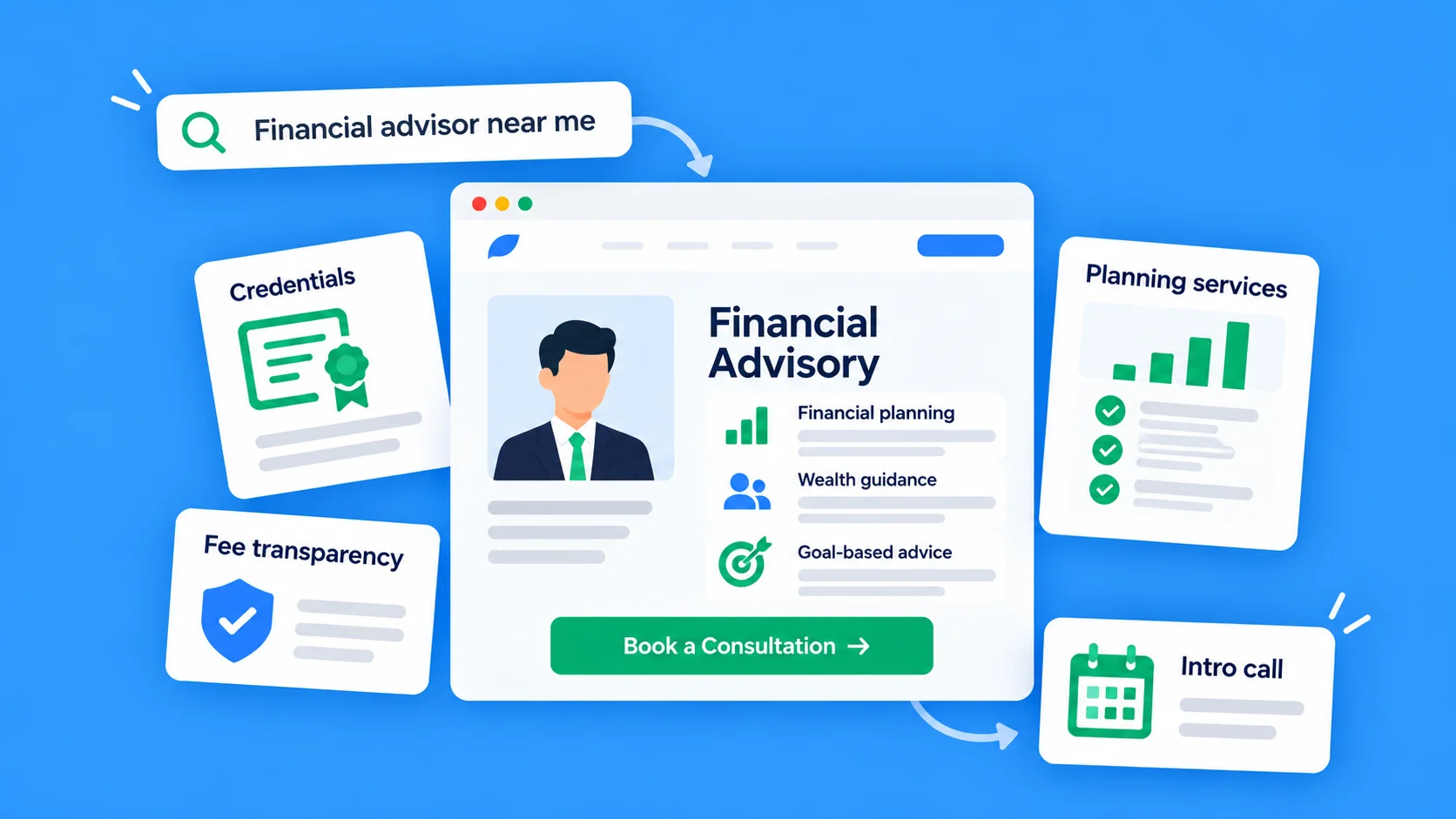
An illustrative financial-advisory website concept. The advisor, credentials and interface shown are fictional.
In this guide18 sections
- 01How clients search
- 02Client and service fit
- 03Meet the example firm
- 04Your website structure
- 05A clearer retirement page
- 06Credibility and fees
- 07Local and remote visibility
- 08Useful educational content
- 09A responsible review process
- 10The consultation journey
- 11Technical foundations
- 12AI-powered search
- 13Measure qualified conversations
- 14Your first 30 days
- 15Common mistakes
- 16Where Blue Kite SEO helps
- 17Frequently asked questions
- 18Your next useful improvement
Someone approaching retirement searches for a financial advisor in Raleigh.
Another person wants to understand what working with a financial planner actually involves. A third has been referred to a local firm but wants to check its credentials, fees and experience before making contact.
All three may end up on a financial advisory website. They arrive with different questions, but they are trying to make a decision that could affect their financial future.
Can this advisor help with my situation? How do they work? What will it cost? And why should I trust the information on this website?
Search engine optimization (SEO) helps financial advisory firms make their services discoverable and understandable when people ask those questions. But appearing in search results is only the first step.
The website also needs to explain the firm's actual services, show verifiable professional information and provide a clear, appropriate path to an introductory conversation.
That takes more than targeting financial advisor near me or publishing a large number of general investing articles.
In this guide, we'll follow a fictional independent retirement-planning firm in Raleigh, North Carolina through a practical SEO improvement plan. You'll see how to organize its website, strengthen its main service page, connect educational content to genuine client needs, explain credentials and fees, and assess enquiries without confusing clicks with clients.
The examples use US English and US financial-services terminology. The underlying website principles are useful internationally, but titles, permitted services, professional rules and advertising obligations must be checked for each country and jurisdiction.
Quick Overview: What Should a Financial Advisor Prioritize?
- Decide whom you actually want to serve. People approaching retirement, business owners, young professionals and families with complex financial needs may need different service information.
- Make your important services easy to understand. A useful retirement-planning page should explain who it is for, what the process involves, which services are included and the next step.
- Show real professional credibility. Describe actual qualifications, regulatory status, experience, team members, services and relevant disclosures accurately.
- Explain fees and the relationship. Don't leave readers guessing what an introductory meeting involves or how the firm is compensated.
- Keep financial content accurate and appropriately reviewed. Tax rules, financial regulations, product features and assumptions change. A polished AI draft is not a compliance review.
- Treat local SEO honestly. Use eligible real locations and profiles; don't claim offices or registration in markets where they don't exist.
- Measure better-fit consultations, not just traffic. More people reading market commentary is not necessarily progress if your goal is a specific type of advisory relationship.
The guiding principle is simple: make it easier for the right person to find the right service, evaluate the right professionals and take an informed next step.
1. Understand How People Look for Financial Advice
Not every prospective client starts by searching financial advisor. Some people search for a professional, some search for a service, and others start with a question about a life transition.
| Illustrative search | What the person might need | Best website destination |
|---|---|---|
| financial advisor Raleigh NC | Evaluate local firms | Homepage, location details and advisor profiles |
| retirement planning advisor near me | Find a relevant planning service | Retirement-planning service page |
| financial planner for small business owners | Check whether a firm serves their business situation | A genuine specialty or client-type page, if applicable |
| what happens at a first financial planning meeting | Understand how the relationship begins | Introductory-meeting guide or process page |
| financial planning fees explained | Understand costs and compensation | Fees and approach page |
| The name of a particular advisor | Check a referral or credential | Accurate advisor biography and relevant disclosure links |
These are examples of possible search intent, not verified keyword volumes or rankings. Research for your actual market should determine the final priorities.
There is a useful difference between someone looking for financial advice now and someone still trying to understand financial planning. Your core service pages should help the first group assess a fit. Supporting educational content can help the second group without pretending every informational reader is a future client.
Referrals and search should work together
Many advisory relationships begin with an introduction from an existing client, colleague or other professional. SEO doesn't have to replace referrals to be useful. It can help a referred person verify the firm before accepting a meeting.
Ask yourself: if someone hears your firm's name today and searches for it, will they find the correct professionals, real services, current disclosures, contact options and a clear explanation of how the firm works?
First action: Write down the three most important service or client-fit searches, then identify which existing page should answer each one. If the right page doesn't exist, that may be a higher priority than a new article.
2. Choose a Client Focus Before Choosing Keywords
Small advisory firms can attract visitors with very different circumstances. A site that tries to target everyone may fail to explain the services it is best equipped to provide.
Start with four questions:
- Who can we genuinely help? Consider the firm's authorized services, experience, capacity and engagement requirements.
- What situations bring those people to us? For example, approaching retirement, managing a business transition or seeking ongoing planning.
- What do we want to grow? One-off plans, ongoing relationships or a particular authorized service are not interchangeable.
- What is outside our scope? Be clear where licensing, geographic coverage, services or minimum engagement requirements limit the fit.
Example: Different niches lead to different pages
| If the firm specializes in… | A relevant page might explain… | What not to assume |
|---|---|---|
| Pre-retirement planning | Who the planning process is for and what conversations it includes | That every visitor needs portfolio management |
| Business-owner financial planning | How business and personal planning topics are coordinated, if genuinely offered | That the firm gives legal or tax advice outside its remit |
| Ongoing investment advisory services | Available services, monitoring approach, responsibilities and fees | That returns or financial outcomes can be guaranteed |
| Advice for a particular professional group | Real experience with that group and actual service distinctions | That a job title alone justifies dozens of niche pages |
A niche page should exist because the firm can explain a meaningfully distinct client need, not because a keyword tool suggested a phrase.
For broader starting priorities, our service-page writing guide helps distinguish a useful service page from generic marketing copy.
3. Worked Example: A Fictional Raleigh Retirement-Planning Firm
Let's use Example Retirement Planning Group, an entirely fictional practice in Raleigh, North Carolina. This is a teaching example, not a real firm, client story, performance record, endorsement or claim of regulatory registration.
Assume its authorized services include financial planning for people approaching retirement, introductory planning consultations and ongoing planning relationships. Any investment-management activities, registrations, compensation structure and professional credentials would need to be defined and verified for a real business before publication.
The firm's preferred prospective clients are adults roughly five to ten years from retirement who want help understanding what a planning relationship could involve. Its existing website looks professional, but most pages say little more than wealth management, personalized solutions and peace of mind.
The firm has also published a stream of general market commentary. Meanwhile, its retirement-planning offer gets only a short paragraph on the homepage.
A website review reveals three gaps
Gap 1: The main service is unclear. A visitor can't tell who retirement planning is for, how it works, or which topics the firm covers.
Gap 2: Credibility is difficult to verify. The advisor biographies are brief, and the site's references to qualifications, firm information and disclosures need a clearer presentation.
Gap 3: Booking lacks context. The only call to action says Contact Us. The visitor can't tell whether the first conversation is an introductory fit discussion, what fees may apply or what information they should prepare.
None of these problems is solved automatically by publishing ten more investing articles.
The first SEO priority is to build a clear retirement-planning journey: search → service page → verified advisors and process → informed introductory enquiry.
4. Give the Firm a Website Structure That Matches Its Actual Services
For this fictional business, a useful starting site map might be:
Homepage
Explain the firm, who it serves, its real location or service reach and clear next steps
Retirement Planning
Explain the principal planning service and whom it is designed for
Our Approach and Fees
Describe the process, engagement structure and compensation accurately
Meet the Advisors
Introduce the real professionals, verified credentials and roles
Who We Work With
Explain a genuine client niche, if a separate page adds value
Resources
Answer focused, reviewed questions that support readers' decisions
Disclosures and Required Documents
Make required or useful regulatory documents accessible where applicable
Request an Introduction
Provide appropriate contact and scheduling information
This is a model, not a required eight-page template. A smaller or differently regulated practice may need another arrangement. Only create separate investment-management, tax-planning, business-owner or other pages if those are real, permitted and meaningfully distinct services.
Avoid service-page overlap
For example, Retirement Planning, Retirement Financial Planning and Financial Planning for Retirement may all address the same reader need. They usually should not become three nearly identical pages.
By contrast, an authorized service for ongoing investment management could deserve its own page when the scope and prospective client's decision differ substantially from a planning engagement.
Internal links should clarify these roles: an educational article about the first planning meeting can link to the firm's process page, which can link to the relevant retirement service and advisor biographies.
5. Rewrite the Retirement-Planning Page: Before and After
Imagine the current page says:
Build a Better Financial Future
We help our clients achieve their goals through personalized wealth management solutions. Contact our experienced team today.
The wording doesn't identify an actual service or explain how someone starts. Achieve their goals can also sound like an outcome promise if the full context isn't carefully handled.
A clearer opening
Here is example copy, assuming the fictional firm's services and location statements are accurate:
Retirement Planning for People Approaching Retirement in Raleigh
If retirement is getting closer and you're wondering what a financial planning relationship could involve, our team can help you explore whether our services fit your needs.
We work with eligible prospective clients who want to review their retirement goals, understand the planning process and discuss the areas of their financial picture that may need attention. We'll explain our services, compensation and next steps before an engagement begins.
Request an Introductory Conversation | Call Our Office
This version answers who, what, where and next step without forecasting investment performance or promising retirement security.
What the rest of the page should contain
| Section | What to explain | What to check |
|---|---|---|
| Who this is for | The kinds of prospective clients the firm can genuinely serve | Actual eligibility, capacity and scope |
| What the service includes | Planning topics, review process and deliverables where applicable | Alignment with contracts, registrations and disclosures |
| What it doesn't include | Important limitations and separately scoped services | No unintended representation that additional advice is included |
| How planning works | Introductory meeting, fit discussion, proposed engagement and service process | Accurate operational steps |
| Who clients work with | Named professionals, roles and verified background | Licensing and professional-title accuracy |
| Fees and compensation | How the firm is paid and where details are explained | Alignment with required fee and conflict disclosures |
| Common questions | What prospective clients want to know before making contact | Qualified, current responses |
| Primary CTA | A low-friction way to request an appropriate first conversation | Actual scheduling and privacy arrangements |
Sample process copy for the website
What happens after you contact us?
1. Tell us what you're looking for. Share a general description of the planning assistance you want, without sending confidential account details.
2. Explore whether we're a fit. We'll explain our services, whom we work with and whether an introductory meeting is appropriate.
3. Understand the engagement. If we can assist, we'll discuss the proposed scope, compensation, required documents and next steps before you decide whether to proceed.
Do not describe the meeting as free unless that's the firm's verified policy. Do not imply that a contact form starts an advisory relationship.
A ready-to-adapt SEO page brief
For this fictional service page, the initial brief might look like this:
| Element | Illustrative specification |
|---|---|
| URL | /retirement-planning/ |
| SEO title | Retirement Planning in Raleigh | Example Retirement Planning Group |
| Meta description | Explore retirement-planning services for people approaching retirement in Raleigh. Learn how our process works, meet the team and request an introduction. |
| H1 | Retirement Planning for People Approaching Retirement in Raleigh |
| Core reader question | Can this firm help someone in my situation, and what does the relationship involve? |
| Internal links | Advisors, Our Approach and Fees, Request an Introduction, and a genuinely relevant supporting article |
| Primary CTA | Request an Introductory Conversation |
| Approval needed | Services, credentials, compensation wording and any regulated financial statements |
The labels and metadata are illustrative, not proof of keyword demand. Review the final wording for accuracy, natural language and applicable compliance requirements before publication.
Practical action: Read your main service page as someone who knows nothing about your firm. Can they understand the service, intended client, actual process, fee approach and next step without calling to ask basic questions?
6. Credentials, Regulatory Information and Fees Are Part of the User Experience
For financial advisors, trust is not created simply by displaying a shield icon or writing independent, experienced and trusted across the homepage.
A prospective client should be able to understand who provides the service, the firm's actual regulatory status, relevant qualifications, how compensation works and where to verify the information.
Build useful advisor profiles
Each real advisor profile can include:
- Name and accurate professional role.
- Current, verifiable registrations and professional designations where relevant.
- Services the person actually handles and jurisdictions or locations that matter.
- Relevant background and experience, described without exaggeration.
- An explanation of how prospective clients work with the advisor or team.
- Appropriate links to the firm's process, services and verification or disclosure resources.
Do not use CFP®, CFA® or other designations unless the particular person is entitled to use them and the marks are presented correctly. CFP Board's verification tool and guidance on using CFP® marks are useful resources for that specific certification.
Help readers verify the business
In the United States, Investor.gov's Investment Adviser Public Disclosure (IAPD) provides access to information about registered investment adviser firms and many representatives, including Form ADV filings. FINRA BrokerCheck covers brokerage firms and individual brokers.
A firm should display accurate registration details and relevant disclosure information as required and appropriate to its actual status, not imply that every kind of financial professional operates under identical rules.
Make fees and relationships understandable
Readers may want to know whether the engagement involves assets-based fees, fixed fees, hourly charges, commissions or some combination. The website should not invent a pricing model, bury material conflicts or imply that fee-only, fiduciary or independent means something the firm's actual circumstances don't support.
For firms subject to the relevant US requirements, Form CRS helps retail investors compare the types of services, fees, conflicts and standards associated with their relationship. See Investor.gov's Form CRS explanation.
You don't need to turn the homepage into a legal filing. You do need an accurate, accessible explanation that is consistent with the firm's required disclosures and compliant marketing materials.
7. Get Local SEO Right Without Pretending to Have More Offices
A firm that genuinely meets clients in Raleigh may benefit from local searches. A firm that works with clients across several states may have a broader reach, subject to applicable registration and service limits.
These are different things. Remote availability isn't the same as a physical office, and a marketing target isn't proof of authorization to serve a client there.
For eligible businesses, Google says local visibility is mainly influenced by relevance, distance and prominence. Complete, accurate business information can help people and Google understand the firm. See Google's local ranking guidance.
Local visibility checklist
- Review the real firm name, office address, hours, phone number and website URL.
- Use accurate services and business categories rather than keyword-stuffed names.
- Show genuine office and team imagery where permitted.
- Confirm that public information matches important professional and business listings.
- Link the local profile to a useful website page.
- Keep advisor contact information and the firm's actual service reach consistent.
- Review whether individual practitioner profiles are eligible before creating them.
Google's Business Profile guidelines explicitly address individual practitioners, including financial planners. That doesn't mean every advisor needs multiple profiles for different specialties. It also does not justify unstaffed virtual offices, false locations or profiles for an online-only operation that doesn't meet eligibility requirements.
Should the firm target nearby cities?
Our example firm might serve suitable clients from Cary and Durham as well as Raleigh. It can explain genuine coverage naturally, but it doesn't automatically need three copies of a Retirement Planning page.
Create separate city pages only where there is meaningful, accurate local value that justifies them. Our guide to targeting multiple cities without duplicate location pages develops that decision in more detail.
For a practice serving remote clients, a useful client-niche or service page may be better than dozens of city pages implying a local presence.
8. Create Educational Content Around Real Planning Questions
Financial advisory firms can easily publish market commentary, definitions and general money tips. The challenge is deciding which content helps the firm's actual prospective clients.
Think about what someone approaching retirement asks before they decide to contact an advisor:
- What happens during a retirement-planning consultation?
- What should I ask when comparing financial advisors?
- How do I understand an advisor's services, fees and compensation?
- What information should I gather before an introductory meeting?
- What is the difference between a one-time plan and an ongoing planning relationship?
These questions can lead to useful, responsibly reviewed articles. They don't require the website to give individualized investment recommendations.
A content map for the fictional firm
| Main page | Supporting guide | Why it deserves to exist |
|---|---|---|
| Retirement Planning | What to Expect From Your First Retirement-Planning Meeting | Makes the consultation process less intimidating |
| Our Approach and Fees | Questions to Ask Before Hiring a Financial Advisor | Helps readers evaluate compensation, scope and services |
| Retirement Planning | One-Time Planning vs. Ongoing Advice: What to Ask | Explains possible service structures without claiming one is universally better |
| Advisor Profiles | How to Check a Financial Advisor's Credentials | Points readers to actual professional verification resources |
| Retirement Planning | What Information to Gather Before Discussing Retirement Goals | Helps readers prepare without collecting sensitive data publicly |
These are editorial examples, not evidence of search volume. Research what your prospective clients ask and check for overlap with existing pages before approving any article.
Worked example: An educational article with a clear purpose
Suppose the firm plans What to Expect From Your First Retirement-Planning Meeting.
A useful opening might be:
Meeting a financial advisor for the first time is an opportunity to understand the firm's services as much as it is an opportunity to talk about your goals. Before agreeing to an engagement, it's reasonable to ask how the firm works, who will provide the service, what information will be needed and how fees are explained.
The article could then cover:
- The difference between an initial fit conversation and an ongoing advisory engagement.
- Questions about available services and advisor qualifications.
- Where fees, compensation and conflicts are explained.
- What general information is useful to have in mind, without uploading account details through an ordinary form.
- How to decide whether a second conversation makes sense.
It would link naturally to the firm's verified Our Approach and Fees page and its Retirement Planning service page.
This article adds value by explaining a decision process. It is not a rewritten copy of the service page, and it does not need to make investment-return claims.
Editorial maintenance is essential
For content that discusses financial rules, tax treatment, benefits, account types or investment products, record:
| Field | Why it matters |
|---|---|
| Applicable jurisdiction | Rules vary by country and sometimes state |
| Responsible reviewer | Someone appropriately qualified must approve the subject matter |
| Sources used | Material factual claims need verifiable support |
| Date last substantively reviewed | Helps the firm plan appropriate maintenance |
| Trigger for updating | Rule changes, product changes or material service changes may require early review |
Do not simply change a publication date to make a page seem fresh. A genuine review should happen first.
9. Financial-Services Marketing Needs Qualified Approval
This is one of the biggest differences between SEO for a financial advisory practice and SEO for a general service business.
A polished page can still contain an inappropriate claim. It might imply guaranteed growth, leave out a material risk, make an inaccurate fiduciary statement or present a client testimonial without the required conditions.
The precise rules depend on the firm.
SEC-registered investment advisers
The SEC's investment adviser marketing rule applies to investment advisers registered or required to be registered with the SEC, within the rule's scope. It contains general prohibitions on materially misleading advertisements and specific conditions for topics such as testimonials, endorsements, third-party ratings and performance advertising.
Testimonials aren't categorically prohibited under this rule, but their use can require disclosures, oversight and other conditions. That is not permission to copy public reviews onto an advisory homepage without compliance review.
State-registered advisers and other financial professionals may be subject to different or additional requirements. The SEC also maintains marketing-compliance FAQs, updated in January 2026.
Broker-dealers and registered representatives
FINRA member firms and their associated persons have separate communications obligations. FINRA Rule 2210 addresses public communications, fair and balanced content, supervision, approval and recordkeeping, with requirements and exceptions depending on the communication.
A financial-services business operating across adviser and brokerage arrangements may need more than one review process. Do not apply the SEC marketing rule to every professional by default, or treat FINRA rules as a universal standard for all planners.
A practical publishing-approval workflow
Before a financial service page, biography, testimonial or educational article goes live:
Verify the business facts. Services, credentials, regulatory details, geography, fees and eligibility must match reality.
Review financial claims. Identify implied guarantees, unbalanced benefits, specific recommendations and missing qualifications.
Check relevant professional rules. Route the material through the firm's actual compliance or supervisory process.
Approve the final version. Confirm what has changed and who authorized publication; retain records as required.
Maintain it. Assign responsibility for later corrections and updates.
AI can help prepare drafts and compare page structures. It cannot substitute for the firm's required professional and compliance approval.
How to apply this guide outside the United States
The website principles in this guide travel well; the regulatory details do not. A firm publishing for a different market should verify its own advertising, registration, credential and approval requirements rather than importing US wording.
| Market | Examples of official verification resources |
|---|---|
| United States | Investor.gov / IAPD and FINRA BrokerCheck, as relevant |
| Australia | ASIC's Financial Advisers Register and relevant AFS licensing details |
| United Kingdom | The FCA Financial Services Register and the firm's applicable permissions |
| Canada | The Canadian Securities Administrators' registration guidance and relevant provincial or territorial requirements |
These resources are starting points for checking professional information, not substitutes for a firm's qualified compliance review.
10. Design the Introductory-Consultation Journey With Privacy in Mind
A website visitor may be interested in advice but hesitant to contact a financial firm. Clear expectations can reduce uncertainty without turning the first form into a request for private account data.
The ideal journey for our example
Relevant search → retirement-planning page → advisor and fee information → request an introduction → fit assessment → appropriate follow-up.
Each step should be clear. A booking request is not proof of suitability, and an initial conversation does not necessarily establish an advisory relationship.
Example consultation section
Is Our Retirement-Planning Service a Good Fit?
If you're approaching retirement and want to understand whether our services are relevant to your needs, you can request an introductory conversation.
We'll explain what our firm offers, how we assess fit, and what the next step may involve. Information about compensation and a proposed engagement will be provided as appropriate before you decide whether to proceed.
Request an Introduction | Call the Firm
Please don't submit account numbers, Social Security numbers, passwords or confidential financial documents through this general inquiry form. We'll explain an appropriate secure process if sensitive information is needed later.
This is illustrative copy, not an approved regulatory disclosure or universal intake policy. The firm should tailor it through its actual legal, compliance and security review process.
Keep the first form focused
An initial marketing form often needs only a name, safe contact method, broad service interest, general location and an optional non-sensitive question.
Avoid requesting complete financial statements, account balances tied to identifying information, tax returns or other sensitive records through an unsecured or inappropriate channel. Detailed fact-finding can take place later through an approved process.
If the business offers online scheduling, state the type of meeting accurately and avoid claiming a no-cost consultation unless that's the actual policy.
Conversion check: Test the full process on a phone, including the booking button, form errors, confirmation message, contact alternatives and what the visitor expects to happen next.
For a more general diagnosis, read our guide to website traffic that doesn't turn into leads.
11. Cover the Technical SEO Basics Before Advanced Tricks
Technical SEO matters when visitors or search engines cannot access or understand the firm's important pages. Start with a focused review.
| Check | Why it matters | Initial action |
|---|---|---|
| Indexing | Important public pages need to be eligible for Google Search | Inspect service-page URLs in Search Console |
| Titles and headings | People should recognize each page's topic | Give each distinct service a clear title and H1 |
| Navigation | Visitors need to find services, advisors, fees and contact information | Connect related pages with useful internal links |
| Mobile usability | Readers must be able to use the site and inquire on their phones | Test menus, buttons, reading and forms |
| Accessibility | Forms and content should be operable for more people | Use labels, legible type and functional controls |
| HTTPS and privacy | Financial-site visitors may share sensitive information | Check secure connections and approved intake systems |
| Canonicals and redirects | Old and duplicate URLs shouldn't fragment the experience | Use consistent preferred URLs and direct redirects |
| Structured data | Appropriate markup can describe genuine organization details | Match visible facts; avoid invented ratings and credentials |
Google's SEO Starter Guide explains the underlying basics. There is no special financial-advisor schema that guarantees ranking or client enquiries.
For our fictional firm, making the retirement page clearer is a better first step than implementing advanced markup while the main service remains difficult to understand.
12. What About Google AI, ChatGPT and Other AI Search Tools?
People may ask AI-assisted systems to explain the difference between financial planning and investment management, prepare questions for interviewing an advisor or identify publicly available firms in a city.
That makes accurate, accessible information important. It does not make an AI recommendation controllable or guaranteed.
Google's 2026 guidance on generative AI search says traditional SEO fundamentals remain relevant. It specifically discourages dependence on so-called AEO or GEO tricks, such as unnecessary AI-specific markup, mechanical content chunking or manufactured mentions.
For a financial advisory website, the practical priorities are the same as those that serve prospective clients:
- Clear descriptions of real services and who they are suitable for.
- Accurate advisor identities, credentials, locations and regulatory information.
- Useful, reviewed educational material rather than unverified financial advice.
- Accessible pages, sensible navigation and relevant internal links.
- Accurate listings and other publicly verifiable business information.
Don't treat one answer from ChatGPT or Claude as a permanent ranking. Answers can change with prompts, sources and the circumstances of the query.
Google introduced dedicated generative AI performance reports in Search Console in 2026. These can help assess visibility within Google's own generative search features. They do not provide a complete report of third-party AI recommendations or establish that visibility turned into clients.
13. Measure Qualified Conversations, Not Just Traffic
The goal of SEO isn't to collect the largest possible number of search impressions. It's to help the firm attract people who understand the service and may be suitable prospective clients.
Keep the measurement stages separate
Google search impressions
- What it actually tells you
- A URL appeared in eligible search results
- What it doesn't prove
- That someone visited the site
Organic search clicks
- What it actually tells you
- Someone clicked from Google Search
- What it doesn't prove
- That the visitor wanted advice
Website visits
- What it actually tells you
- Recorded sessions or visits in configured analytics
- What it doesn't prove
- That the visit came from organic search or led to an enquiry
Phone and booking-button clicks
- What it actually tells you
- Someone interacted with a contact option
- What it doesn't prove
- That a call or booking was completed
Confirmed enquiries
- What it actually tells you
- Contact was actually received
- What it doesn't prove
- That the firm can serve the person
Qualified introductory conversations
- What it actually tells you
- The initial screening identifies a potential fit
- What it doesn't prove
- That an engagement has begun
New client engagements
- What it actually tells you
- An actual relationship was established
- What it doesn't prove
- That SEO alone caused the decision
A fictional reporting example
Suppose the retirement page receives 180 organic visits in a month. It records 15 contact-option interactions, 9 confirmed enquiries, 5 enquiries that meet the firm's basic fit criteria, 3 completed introductory meetings and 1 new client engagement.
These figures are illustrative only.
They are not industry conversion benchmarks or performance forecasts.
The reporting value is in seeing where potential friction or mismatch occurs. If enquiries are regularly outside the firm's service scope, the page may not explain client fit clearly enough. If people visit the service page but can't complete the form, the intake experience needs work.
Do not put sensitive client information into ordinary marketing analytics. Use appropriately configured systems and observe the firm's privacy, recordkeeping and supervisory obligations.
A monthly reporting note worth keeping
That is more useful than claiming every new client was generated by SEO.
14. A 30-Day SEO Action Plan for Financial Advisors
An independent firm doesn't need to launch twenty projects at once. Start with the work most connected to its real service priorities.
1: Understand
- Primary action
- Confirm target clients, actual service scope, existing pages, regulatory status and intake experience
- Finished result
- A prioritized website-gap list
2: Improve
- Primary action
- Strengthen one key service page, verify claims, clarify the CTA and complete required approvals
- Finished result
- One useful, approved service page
3: Build trust
- Primary action
- Improve advisor biographies, fee/process information, eligible local listings and contact usability
- Finished result
- Clearer credibility and enquiry pathways
4: Connect and measure
- Primary action
- Review supporting content, internal links, Search Console data and actual enquiries
- Finished result
- A practical next-month plan
Your 20-minute website self-check
Ask these ten questions about your most important service page:
- Does the headline identify the actual service and intended client?
- Is the firm's real geographic or regulatory scope represented accurately?
- Does the page explain what's included and where service boundaries lie?
- Can readers identify and verify the relevant professionals?
- Is the process described in plain language?
- Are fees, compensation or the path to the relevant disclosures clear?
- Are financial claims accurate, appropriately qualified and approved?
- Are useful educational articles linked without repeating the same page purpose?
- Can someone complete an introductory enquiry on a phone without sharing sensitive financial records?
- Can the firm measure confirmed, suitable enquiries rather than relying on clicks alone?
If several answers are no, improving that page may be more useful than commissioning new articles immediately.
15. Common Financial Advisor SEO Mistakes
Targeting everyone. A firm trying to rank for every type of advice may never clearly explain whom it serves best.
Publishing more commentary than service information. Market updates can have a purpose, but they don't replace well-explained retirement or planning services.
Using vague trust language instead of verifiable facts. Claims such as trusted, top-rated and fiduciary need accurate context. Real credentials and transparent information matter more than decorative badges.
Hiding the fee conversation. Visitors don't necessarily need a universal price posted on every page, but they should understand how fees and compensation are explained and where required information is available.
Publishing unsupported performance or outcome claims. Projections, testimonials, rankings and investment-related comparisons can trigger particular obligations. Never assume a generic disclaimer fixes an inappropriate claim.
Inventing locations or specialties. Remote clients don't justify fictitious offices or city pages, and keyword volume doesn't establish authorization to provide a regulated service.
Automatically publishing AI-generated financial content. AI can be helpful for drafting, but unverified material may misstate regulations, services, fees or investment risks.
Counting contact clicks as clients. A button interaction is not a completed call, confirmed consultation or signed engagement.
The solution is not to stop producing content. It is to choose work because it helps the firm and its prospective clients, and publish through an appropriate review process.
16. Where Blue Kite SEO Fits
You can carry out these improvements internally, with your existing marketing team or with outside specialists.
The difficult part for a busy practice is often deciding what deserves attention each month and keeping the work connected.
Blue Kite SEO is a strategy-led SEO platform for small service businesses. It begins with a Business Profile describing actual services, customers, locations and priorities, then uses a Website Review to examine available information.
From there, it prepares an SEO Strategy and an ongoing Monthly Plan to guide useful website work.
That work can include improving an existing service page, creating a genuinely missing page, preparing supporting content or identifying other supported website tasks. The business can review the recommendations and prepared materials before they are published.
Compatible WordPress websites support selected draft, publishing and website-management actions; other websites may require manual implementation or developer instructions.
For our fictional firm, a strategy-led plan would prioritize a missing retirement service page and an unclear enquiry process before another large batch of investing articles.
Financial advisory firms remain responsible for their own regulatory obligations, professional review, financial accuracy, required approvals, records and data protection. Blue Kite SEO does not provide investment advice, replace supervisory or compliance review, perform a comprehensive regulatory audit, or guarantee rankings, recommendations or new clients.
Explore how Blue Kite SEO works or review plans and pricing.
Frequently Asked Questions About SEO for Financial Advisors
Is SEO worthwhile for a small financial advisory firm?
It can help suitable prospects discover the firm and help referrals verify what the firm actually offers. Its value depends on the services, market, website, competition and ongoing execution. Begin with your most important service pages and the quality of enquiries, rather than assuming more traffic always means growth.
Should we target "financial advisor" or "financial planner"?
Use the terms that accurately reflect the services and professionals involved, and investigate how prospective clients search in your market. A firm with a distinct retirement-planning offer may need a stronger page about that service instead of focusing exclusively on one broad term.
Is it "financial advisor" or "financial adviser"?
Both spellings are used. Financial advisor is common in US marketing searches, while US regulatory materials often use investment adviser. In Australia and some other markets, financial adviser is more familiar. Use accurate professional terminology, write naturally for your primary audience and don't create duplicate pages solely to target both spellings.
Do we need a separate page for every client niche?
No. Create a niche page when the firm genuinely serves that group and can provide information that differs meaningfully from its general service pages. Otherwise, improve the relevant service page rather than duplicating it.
How important is a Google Business Profile?
For an eligible firm that serves clients in person, accurate local information may help people discover and evaluate the business. Eligibility and practitioner-profile rules matter. Don't claim offices that don't exist or create a listing simply because the firm can meet remotely.
Can financial advisors use client reviews or testimonials on their website?
Possibly, but the conditions depend on the firm's regulatory status, how the material is used and applicable rules. The SEC's investment adviser marketing rule permits certain testimonials and endorsements subject to requirements; other professional rules may also apply. Obtain qualified compliance review rather than assuming all reviews are automatically permitted or prohibited.
Can AI write our retirement-planning articles?
AI can help outline, structure and draft content, but suitably qualified staff must verify facts, applicable rules, services, financial claims and required disclaimers before publication. Do not upload confidential client data to unapproved systems or automatically publish unreviewed drafts.
How do we show credentials without overloading the website?
Give each advisor a clear, useful profile, link to relevant verification and disclosure resources, and present accurate titles and professional designations. More badges do not substitute for current, verifiable credentials.
How do we appear in Google AI Overviews or ChatGPT recommendations?
There is no guaranteed recommendation method. Improve the accuracy, usefulness and accessibility of your public information, follow sound SEO practices and monitor what can be measured. A single AI response isn't a stable ranking.
What should we measure besides Google clicks?
Separate impressions, organic visits, contact interactions, actual enquiries, suitable introductory consultations and new engagements. Use appropriate privacy and compliance controls, and don't assume each enquiry was generated solely by SEO.
The Bottom Line: Make the Right Financial Advice Easier to Discover and Evaluate
SEO for financial advisors isn't about publishing more financial content than competing firms.
It's about helping a suitable prospective client understand whether you offer the service they need, who will provide it, what the relationship involves, how compensation works and what happens before they commit.
Start with the services you genuinely want to grow. Improve their pages. Show verifiable professional information. Maintain current, appropriately reviewed educational content. Keep local details truthful and the introductory process simple. Then measure whether better-fit prospective clients are getting in touch.
The best next SEO task is the one that makes your firm easier to find, understand and evaluate responsibly.