SEO for Accountants and CPA Firms: How to Attract Better-Fit Clients and Grow Beyond Referrals
An actionable guide to accounting-firm SEO, with a complete small-firm website example, service-page copy, local visibility advice, seasonal content ideas, and a 30-day plan.
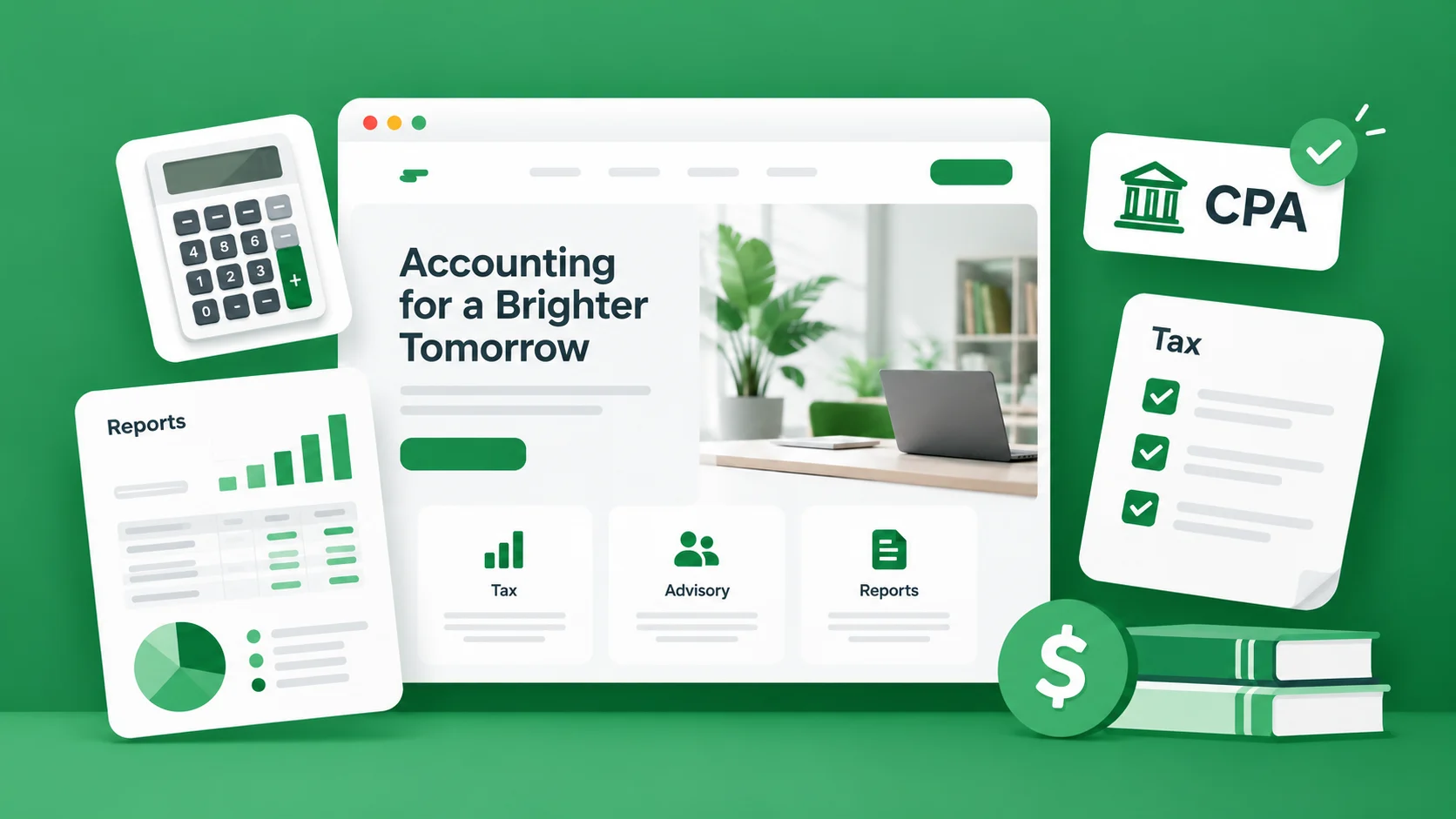
An illustrative accounting website concept. The firm, reports and interface shown are fictional.
In this guide17 sections
- 01Client and service fit
- 02Meet the example firm
- 03Your website structure
- 04A stronger advisory page
- 05Professional credibility
- 06Local and remote visibility
- 07A useful content plan
- 08Seasonal content maintenance
- 09A clearer inquiry journey
- 10Technical foundations
- 11AI-powered search
- 12Measure the right inquiries
- 13Your first 30 days
- 14Common mistakes
- 15Where Blue Kite SEO helps
- 16Frequently asked questions
- 17Your next useful improvement
A business owner can be perfectly happy with the accountant who prepares their tax return and still need a different kind of help.
Perhaps the company is growing, but its reports arrive too late to inform decisions.
Maybe the owner wants someone to explain cash flow, not just categorize transactions. Or perhaps they are looking for a CPA firm that understands the accounting challenges of their particular industry.
They might ask a colleague for a recommendation. They might search Google for small business CPA near me, outsourced accounting services, or monthly financial reporting for growing businesses. They might even ask an AI assistant what kind of accountant they should hire.
Those searches do not all describe the same client, service, or buying decision.
That distinction is the foundation of useful SEO for accountants: attracting people whose needs match the work your firm genuinely provides, then helping them understand why contacting you makes sense.
In TaxDome's 2025 Niche Business Accounting Report, which surveyed 353 US business decision-makers, 58% said a referral was the primary way they found their current accountant and 17% reported online search.
That's one survey of business clients, not a universal market benchmark. But it illustrates an important point: your website should support both people discovering your firm through search and people researching a recommendation.
This guide shows how to do that without turning your website into a collection of generic tax articles.
We'll follow a fictional CPA firm through its service priorities, website structure, advisory-service page, trust signals, content plan, and consultation process.
The main examples are US-first. The approach can also help accountants, bookkeepers, chartered accountants, and tax advisors elsewhere, provided local terminology, qualifications, laws, and professional requirements are adapted appropriately.
Quick Overview: What Matters Most for Accounting-Firm SEO?
- Know which clients you want more of. Individual tax returns, business compliance, bookkeeping, payroll, and ongoing advisory can require different pages and messages.
- Improve service pages before chasing article volume. Give every important service a clear purpose, scope, audience, and next step.
- Make your real expertise visible. Show actual credentials, responsible professionals, specializations, and a truthful description of how you work.
- Use local SEO accurately. Keep eligible business listings, office details, and service locations correct. Don't invent branches or create copy-and-paste city pages.
- Publish tax information selectively. Useful guides can attract the right people, but regulations, deadlines, and thresholds change. Professional review and ongoing maintenance matter.
- Design a secure, clear inquiry process. Make it easy to ask about services without requesting tax returns or sensitive financial records through an ordinary marketing form.
- Measure suitable inquiries, not only visits. A smaller number of ongoing advisory clients may be more relevant to your goals than a large number of unsuitable seasonal inquiries.
The guiding question is simple: What should the right prospective client understand about your firm before making contact?
1. Start With the Clients and Services You Actually Want
A common SEO mistake is to target the broadest possible version of accountant and assume that more traffic must mean more business.
But an accounting firm may serve several quite different needs:
| Service or client need | What the person may be looking for | What your website should clarify |
|---|---|---|
| Individual tax preparation | Help preparing a personal tax return | Which returns you handle, who you serve, how the process works, and whether you're accepting clients |
| Business tax services | Returns, compliance support, and applicable tax planning | Business types, scope of work, qualifications, and engagement process |
| Bookkeeping and monthly accounting | Reliable records, reconciliations, and financial reporting | Whether the service is ongoing, what's included, and what the client supplies |
| Payroll services | Help with recurring payroll work | Actual payroll scope, systems supported, and service boundaries |
| Business advisory | Someone to discuss reports, cash flow, and decisions with | Who the service is for, what meetings or deliverables involve, and how it differs from compliance work |
| Industry-specific accounting | A professional who understands a particular business model | Genuine experience and relevant service details for that industry |
These are examples of different reader intentions, not recommendations to create every page regardless of what you offer.
The difference between tax and advisory searches
Imagine two visitors:
- A sole proprietor needs help filing a return before the applicable deadline.
- An established business owner wants recurring management reporting and regular financial discussions with an accountant.
A generic Accounting Services page may not explain either offer well. Both visitors need to know what the engagement includes, but the questions they're asking are different.
Practical exercise: Build your client-fit brief. Write down your top three services, the types of clients you want, your genuine service locations or markets, and the inquiries you don't want. If the firm isn't currently accepting one-off individual tax clients, don't design the homepage primarily to attract them.
2. Worked Example: A Small CPA Firm That Wants More Advisory Clients
For the rest of this guide, imagine Maple Street CPA, a completely fictional firm in Charlotte, North Carolina.
The example assumes it genuinely offers:
- Business tax preparation and related services.
- Monthly bookkeeping and accounting support.
- Recurring reporting and business advisory conversations.
- Consultations for prospective small-business clients.
Its preferred growth area is ongoing accounting and advisory relationships with established small businesses. It isn't trying to increase every type of seasonal tax inquiry.
This is not a real firm, testimonial, earnings claim, or performance case study. The example illustrates how an SEO plan could follow business priorities.
What its current website gets wrong
The fictional homepage says:
Reliable Accounting and Tax Solutions
We provide personalized bookkeeping, tax, and accounting services for individuals and businesses. Contact us today for expert support.
It mentions services, but it doesn't make the firm's priority clear. A visitor can't tell whether the firm provides recurring advisory support, how that service works, or who it's designed for.
The site also has fifteen short tax articles, but no useful standalone page explaining its monthly accounting and advisory service.
Maple Street doesn't primarily have a blog-volume problem. It has a service-positioning and website-structure problem.
Its first SEO priority should be to explain the work it most wants to attract.
3. Give Every Important Accounting Service a Clear Place on the Website
A useful website structure makes it easy to move from a question to the right service, professional, and inquiry method.
For our fictional firm, a starting architecture could be:
Homepage
Explain who the firm helps, its core services, location, and preferred next step
Monthly Accounting & Advisory
Explain the ongoing service the firm wants to grow
Small Business Tax Services
Explain actual business tax services without promising tax outcomes
Bookkeeping Services
Show what recurring bookkeeping does and doesn't include
Our CPAs and Team
Present real people, verified credentials, roles, and experience
Who We Work With
Clarify relevant business types or specializations, where genuinely supported
Resources
Answer focused questions that support service decisions
Contact / Book a Consultation
Explain inquiries, screening, fees or fee discussions, and next steps
Not every accounting practice needs all eight pages. A solo bookkeeper, a personal-tax specialist, and a multistate CPA firm should have different structures.
Don't give two pages the same job
For example, Business Accounting and Monthly Bookkeeping may deserve separate pages if they really describe different services and customer needs.
But Accounting for Small Businesses, Small Business Accountants, and Business Accounting Services should not automatically become three near-identical pages just to target three keyword variations.
Use one strong page per distinct service or reader need, supported by logical internal links. See our guide to writing a service page that attracts the right customers for the general approach.
Example: A sensible internal-link path
Someone reads an article about the difference between bookkeeping and monthly management reporting.
That article links to Monthly Accounting & Advisory, where the visitor sees which support is included. From there, they can see the relevant team profiles and Request a Consultation.
Another reader looking specifically for tax-return preparation goes directly to Small Business Tax Services.
The paths reflect the services rather than pushing every visitor through the same sales pitch.
4. Rewrite the Advisory Service Page: Before and After
Let's improve Maple Street CPA's highest-priority page.
Before:
Professional Business Advisory Services
Our experienced accountants help businesses achieve their goals through quality financial solutions and personalized advice. Get in touch to learn more.
It could describe almost any firm. There is no useful explanation of the service, the client, or the process.
After, using only the fictional services we've established:
Monthly Accounting & Advisory for Growing Charlotte Businesses
Need more than completed books at the end of the month? Our ongoing service combines the accounting support your business needs with regular financial reporting and conversations about what the numbers mean.
We work with suitable small-business owners who want clearer information to support day-to-day decisions. We'll discuss your current systems, reporting needs, and whether an ongoing engagement is a good fit.
Talk to Us About Monthly Advisory | Call Our Office
It's clearer without claiming guaranteed profits, tax savings, or financial results.
What the full service page should answer
| Section | Example information to include | What to verify before publishing |
|---|---|---|
| Who it's for | Established small businesses seeking recurring accounting support | Actual client criteria and service capacity |
| What is included | Monthly reporting, reconciliations, advisory meetings, or other real deliverables | The firm's actual engagement scope |
| What isn't included | Services excluded from the plan or separately scoped | Whether tax, payroll, audits, or other work is included |
| How it works | Introductory discussion, fit assessment, proposal, onboarding | Actual client onboarding process |
| Who provides the service | Responsible CPAs, accountants, bookkeepers, and their roles | Credentials, licenses, and staff responsibility |
| Software and collaboration | Platforms the firm genuinely supports, secure file exchange | Actual tools, certifications, and security practices |
| Fees | Fee model or when scope and pricing will be discussed | Actual pricing and engagement terms |
| Next step | A short consultation request and clear expectations | Availability, screening, and response process |
Sample copy for the process section
What happens next?
1. Tell us about your business. Share your industry, broad accounting needs, and the kind of ongoing support you're looking for.
2. We'll check the fit. Our team will confirm whether the services and capacity align with your requirements and explain the next conversation.
3. Discuss scope and onboarding. If we're a match, we'll explain the proposed work, information required, fees, and next steps before an engagement begins.
A process like this helps someone understand the decision before speaking to the firm. It should be adjusted to match real policies, not copied verbatim where it doesn't fit.
Practical action: Choose the service you most want to grow. Audit its page for a specific audience, actual deliverables, scope limits, professional credibility, and a clear inquiry path. A useful improvement here may matter more than another general tax blog post.
5. Demonstrate Expertise Without Making Unsupported Claims
Accounting customers are entrusting a firm with important financial information and decisions. Trust is built through specific, verifiable details, not statements such as we're the best accountants in town.
Show the people behind the work
A useful CPA or accounting team profile can include:
- The person's name and actual professional role.
- Verified CPA licensure, enrollment, or other credentials where applicable.
- Relevant services and professional experience, accurately described.
- Genuine industry expertise or specialization, if the person has it.
- Professional memberships and software certifications only when current and real.
- Who clients work with during onboarding or an ongoing engagement.
The term CPA has professional and legal meaning in the United States.
Not every bookkeeper, accountant, or tax preparer is a CPA. Avoid using credentials or titles your team doesn't hold; requirements and permitted services can vary by state and other jurisdiction.
For firms outside the US, local designations such as chartered accountant or other professional credentials should be used accurately, not replaced with CPA for marketing convenience.
Make industry specialization real
A page labeled Accounting for Construction Companies should contain more than a paragraph saying you work with construction businesses.
If it's a real area of expertise, the page could explain relevant accounting services, common business questions you can responsibly discuss, how onboarding works, and the qualified people who handle the work. You don't need to invent a project or claim that every construction client receives a particular outcome.
This is where your firm's experience can make its website distinct from generic AI-written content.
Reviews and case examples
Reviews can provide social proof, but they need to reflect genuine experiences.
Never invent testimonials, fabricate outcomes, or publish identifiable client financial information without appropriate authorization.
Google forbids incentives for reviews on Google Business Profiles. Its review policy also emphasizes honest, authentic feedback.
A verified, permissioned case example can describe the starting situation, actual engagement, and the result you can substantiate. If you don't have permission to publish a case, use clearly labeled hypothetical examples instead.
6. Local SEO for CPA Firms, Including Firms That Work Remotely
A local search such as CPA firm Charlotte is not the same as a national search such as outsourced accounting for ecommerce businesses.
Many practices serve a local market, some work with clients remotely, and some do both. Your website should describe the reality rather than pretending to have an office in every city.
Get your Google Business Profile right
For an eligible firm with a genuine customer-facing office, confirm:
- The business name, address, phone, hours, and primary website URL.
- Accurate service categories and a complete description.
- Genuine business photographs and current information.
- A useful website landing page matching the firm's services.
- An appropriate process for responding to reviews without sharing private client details.
Google says local results primarily depend on relevance, distance, and prominence.
Accurate information helps Google understand the business, but nobody can pay for a better organic local ranking. Read Google's local ranking guidance.
Remote clients don't justify fake offices
An accounting practice offering remote work doesn't automatically qualify for a Google Business Profile in every market. Online-only businesses without eligible in-person customer contact generally don't qualify, and a mailing address or unstaffed virtual office isn't a legitimate branch.
Use Google's Business Profile eligibility rules before creating or changing listings.
If your firm genuinely serves clients in several cities or states, accurately describe that coverage on the website and check any professional or regulatory limits. Don't create identical city pages with only the place name changed.
For a more detailed framework, see our guide to targeting multiple cities without duplicate location pages.
Local search versus specialist reach
Maple Street CPA may benefit from local visibility in Charlotte for general business accounting. But a genuinely specialist firm with an established niche may also serve suitable clients outside its immediate area.
That doesn't mean it should create a landing page for fifty cities. It may be more useful to publish one strong, appropriately scoped page about the specialized service and let accurate service information explain geographic reach.
7. Build a Content Plan Around Real Accounting Questions
Accounting firms have no shortage of potential article topics. The challenge is choosing the ones that serve a purpose.
Some questions signal immediate service intent:
- CPA for small business tax returns
- Monthly bookkeeping services for a growing company
- Outsourced accounting and financial reporting
Others are informational:
- What's the difference between bookkeeping and monthly accounting?
- What should I bring to a first meeting with a CPA?
- When does a business need management reports rather than basic bookkeeping?
The first group generally belongs on well-designed service pages. The second may justify useful supporting guides that connect readers to relevant services.
A sample content map for our fictional firm
| Priority page | Supporting content idea | Reason it exists |
|---|---|---|
| Monthly Accounting & Advisory | Bookkeeping vs. Monthly Management Reporting: What's the Difference? | Helps an owner understand two distinct levels of support |
| Monthly Accounting & Advisory | Five Questions to Ask Before Hiring an Ongoing Accounting Partner | Helps prospective clients evaluate a recurring engagement |
| Bookkeeping Services | What Happens During a Month-End Close? | Makes the recurring process clearer |
| Small Business Tax Services | How to Prepare for Your First Business Tax Appointment | Explains practical preparation without guessing tax eligibility |
| Our Team / Who We Work With | How We Approach Accounting for [Genuine Industry Niche] | Demonstrates relevant experience and service boundaries |
Notice what is missing: ten versions of the same small business tax deductions article.
8. Tax-Season Content Is Useful, but It Needs an Expiration Plan
Tax season is an obvious time for search activity around accounting services. However, many tax guides quickly become stale.
Rules, thresholds, forms, deadlines, eligibility, and administrative guidance can change. Even when a general principle remains the same, a page titled with a particular tax year needs checking before it is promoted again.
Think in two content categories
| Content type | Example | Maintenance approach |
|---|---|---|
| Evergreen process guidance | How to prepare for an initial business tax consultation | Review when firm procedures or relevant rules change |
| Year- or rule-specific tax content | A guide about a named tax year's filing deadline or eligibility rules | Professional fact-check, source verification, jurisdiction and date review before publication and when rules change |
A general guide doesn't need a fake annual update to look fresh. A time-sensitive article shouldn't stay live with unverified figures merely because it still attracts visits.
An illustrative annual editorial rhythm
Before and during relevant filing periods: Clarify which clients the firm accepts, appointment procedures, secure document exchange, and current service availability.
Outside the busiest compliance periods: Explain the difference between bookkeeping, reporting, and advisory work; improve important service pages.
When tax rules or business requirements actually change: Publish a qualified explanation for the right jurisdiction, if it serves your clients and your firm can maintain it.
Throughout the year: Use verified client questions to update FAQs and service descriptions.
This is a planning framework, not a calendar of legal tax deadlines. Deadlines depend on tax type, jurisdiction, taxpayer circumstances, and current rules. Do not publish dates from a general AI draft without checking official sources.
Who reviews the tax information?
Google treats topics that may significantly affect people's financial stability as especially trust-sensitive in its people-first content guidance.
In the US, IRS Circular 230 guidance addresses duties and misleading advertising for practitioners subject to its rules. A firm should apply qualified professional review, and all published claims should meet its applicable state and federal obligations.
For each substantial tax article, record the jurisdiction, relevant tax period, responsible reviewer, sources checked, and date of review. Be ready to correct or retire outdated material.
AI can help organize a draft. It cannot take responsibility for a tax statement published under your firm's name.
9. Make It Easy to Inquire, Without Asking for Sensitive Records Too Early
For accountants, a consultation isn't just a generic sales call. The firm may need to establish the client's service needs, determine whether it can accept the work, and explain the engagement process.
The website can reduce uncertainty before anyone shares personal financial information.
Example: A better call to action
Instead of putting Get a Free Quote on every page, our fictional advisory page might say:
Looking for Ongoing Accounting Support?
Tell us a little about your business and the kind of help you're looking for. We'll review whether our services are a suitable fit and explain how an introductory conversation works.
Request an Introductory Conversation | Call Our Office
Please don't upload tax returns, financial statements, Social Security numbers, or other sensitive records through this initial form. If documents are needed later, we'll explain the appropriate secure process.
No vague promise, no assumption that all consultations are free, and no request for detailed tax data in an ordinary marketing form.
A useful initial inquiry form
Keep the first form focused on information needed to route the request:
- Name and contact method.
- Broad service interest, such as tax, bookkeeping, or ongoing advisory.
- Business type or industry, where relevant.
- General location or jurisdiction.
- A brief non-confidential description of what the prospective client is looking for.
If the firm offers online booking, explain whether the appointment is an initial fit conversation or a substantive professional consultation, and how fees are handled where relevant.
Security and consent are part of trust
US tax return information can be subject to strict disclosure and use restrictions, including Internal Revenue Code Section 7216. These rules are not something a marketing consent checkbox can safely be assumed to solve.
Refer to the applicable professional and legal requirements before using identifiable client material for case studies, testimonials, targeting, or AI-assisted workflows.
The IRS also emphasizes that tax professionals need a suitable Written Information Security Plan (WISP) to safeguard taxpayer information. See its 2026 guidance on protecting client data.
Your marketing website and inquiry process should fit those responsibilities. Use an appropriately managed secure portal for sensitive documents where applicable, and do not paste identifiable tax records into unapproved AI tools.
Check the whole mobile journey
On a phone, can someone easily understand what you do, find a real professional profile, see the inquiry button, complete the first form, and know what happens next?
If visitors arrive but suitable inquiries don't follow, the problem may be service clarity or the inquiry process rather than visibility alone. Read our guide to website traffic that doesn't turn into leads.
10. Get the Technical SEO Basics Right
Technical problems can stop an otherwise useful page from being found or used. Start with the essentials rather than assuming your firm needs a complex audit.
| Check | Why it matters | First action |
|---|---|---|
| Indexing | Important public service pages need to be eligible for indexing | Inspect priority URLs in Google Search Console |
| Clear titles and headings | Visitors should immediately recognize the page's purpose | Give distinct services descriptive page titles and H1s |
| Internal navigation | People should find key services, credentials, and contact information easily | Link related services, staff profiles, and helpful articles |
| Mobile usability | Visitors need usable menus, text, buttons, and forms | Test the full inquiry journey on a phone |
| Page performance | Slow or unstable pages can harm the visitor experience | Optimize large images and address real usability issues |
| Canonicals and redirects | Old or duplicate URLs should resolve consistently | Check preferred URLs and avoid redirect chains |
| Accessibility | Forms and content should be understandable and operable | Label fields and keep controls keyboard-accessible |
| Structured data | Accurate markup can describe real organization details | Use supported markup only when it matches visible facts |
Use Google's SEO Starter Guide for the underlying principles.
A firm that has a five-page website with weak service descriptions is unlikely to benefit most from obsessing over schema before addressing the content and inquiry experience.
11. What About Being Found Through ChatGPT and Google AI?
Prospective clients may use AI-powered search to compare types of accounting services, understand the difference between a CPA and a bookkeeper, or look for providers.
That creates a useful reason to publish clear, accurate information, but it doesn't create a guaranteed shortcut to recommendations.
Google's guidance for generative AI search emphasizes established SEO fundamentals and distinctive, people-first content. It advises against chasing supposed AEO/GEO tricks such as unnecessary AI-specific text files or manufactured mentions.
For accounting firms, sensible priorities include:
- Describe real service offerings and the clients they're suitable for.
- Maintain accurate credentials, team information, locations, and business listings.
- Publish useful, reviewed explanations instead of generic, mass-produced tax content.
- Let important pages be crawled and indexed where intended.
- Make it easy to connect an explanation to the responsible professional and relevant service page.
You can occasionally test what web-enabled AI tools find about your firm, noting the date and sources. But a single ChatGPT or Claude answer is not a stable ranking or evidence of guaranteed recommendation visibility.
12. Measure Better-Fit Inquiries, Not Just Higher Traffic
SEO reports can make a growing number of website visits look like success. But the firm's original goal matters.
If Maple Street CPA wants more recurring advisory clients, a burst of one-off individual tax inquiries may be less useful than a smaller number of qualified ongoing-service conversations.
Separate these measures
| Metric | What it actually means | Common mistake |
|---|---|---|
| Search impressions | The page appeared in eligible Google search results | Treating an impression as a visitor |
| Organic clicks | A Google searcher clicked through | Assuming every click was a prospective client |
| Website visits | Tracked visits, subject to analytics setup and consent | Assuming they all came from organic search |
| Phone-link clicks | Someone activated a call link | Counting every click as a completed call |
| Confirmed inquiries | A real form, call, booking, or message reached the firm | Counting spam or duplicate contacts |
| Qualified opportunities | Inquiries that fit the firm's services, location, and capacity | Treating every inquiry as suitable |
| New engagements | Clients who actually engage the firm | Attributing every new client solely to SEO |
Fictional measurement example
Suppose the advisory page records this activity over a period:
240 organic search visits.
20 clicks on its contact or booking options.
11 confirmed inquiries.
6 inquiries that match the firm's advisory criteria.
3 introductory meetings.
1 new ongoing engagement.
These are illustrative numbers only, not accounting-industry benchmarks or forecasts.
The important thing is being able to investigate each stage. If people click the page but don't understand the offer, improve its clarity.
If many inquiries are unsuitable, reconsider the audience, wording, and screening questions.
If a high-intent page rarely appears in search, investigate its discoverability and relevance.
Review Search Console, appropriately configured website analytics, and the firm's own inquiry or practice-management records. Protect client privacy and be careful with attribution: SEO often works alongside referrals, direct traffic, and other channels.
13. Your First 30 Days: A Practical SEO Plan for an Accounting Firm
Don't attempt to rebuild the entire website or publish a large volume of articles immediately.
Week 1: Decide
- Priority
- Identify priority services, ideal clients, existing pages, and genuine service locations
- Concrete deliverable
- A short list of high-value website gaps
Week 2: Improve
- Priority
- Rewrite one important service page, clarify scope and CTA, connect staff profiles
- Concrete deliverable
- One complete, fact-checked service page
Week 3: Build trust
- Priority
- Verify team credentials, office information, business profiles, mobile inquiries, and secure intake
- Concrete deliverable
- More credible business information and a clearer inquiry path
Week 4: Connect
- Priority
- Review existing articles, improve internal links, inspect Search Console, and choose the next priority
- Concrete deliverable
- A focused next-month SEO plan
A five-question priority test
Before choosing the next task, ask:
Does this support a service we genuinely want to grow?
Is the information missing, confusing, outdated, or hard to find?
Does it help a real client make a useful decision?
Can we review and maintain it responsibly?
Is it more important than the other work we could do now?
For Maple Street CPA, the top priority was a strong Monthly Accounting & Advisory page. Another firm might first need accurate office information, a better business-tax service page, or a safer inquiry process.
There is no universal publishing quota that makes those decisions for you.
14. Mistakes That Make Accounting SEO Less Useful
Targeting everyone. If your site markets individual returns, bookkeeping, outsourced CFO work, and audit services without explaining what you actually provide, the most relevant visitors may leave confused.
Confusing credentials and services. Don't label an employee a CPA unless they actually hold that designation, and don't imply the firm performs audits, investment advice, or regulated services it doesn't provide.
Churning out interchangeable tax articles. Dozens of similar deduction posts may add maintenance obligations without improving the pages that generate suitable inquiries.
Recycling old tax facts. A statement that was accurate last year may not apply to a new period, person, or jurisdiction.
Creating fake local reach. A nationwide remote service is not proof of a physical office in each city. Use accurate office and service information.
Claiming guaranteed savings or results. Avoid unsupported promises about refunds, tax reductions, financial outcomes, or business growth.
Using clients' financial information for content without proper authorization. Confidentiality and tax-information rules matter to marketing, AI workflows, testimonials, and case studies.
Measuring clicks as clients. Search traffic is one piece of the journey. Connect reporting to confirmed, suitable inquiries and real engagements.
15. How Blue Kite SEO Helps Put the Right Work Into a Plan
You can apply the ideas in this guide yourself. The ongoing challenge is deciding what the website needs each month, getting the right work prepared, and keeping it connected to your firm's priorities.
Blue Kite SEO is a strategy-led SEO platform for small service businesses. It begins with a Business Profile describing your services, customers, locations, and goals, followed by a Website Review of available information.
It then prepares an SEO Strategy and an ongoing Monthly Plan to identify useful website work before producing more content.
Depending on the plan and supported platform capabilities, Blue Kite SEO can prepare new or improved pages, supporting articles, and selected website changes for owner review.
Compatible WordPress connections support certain draft, publishing, and website-management actions; for other sites, the platform can provide content and relevant implementation instructions.
An accounting firm might use it to prioritize a weak advisory page over another general tax article, then prepare the improvement as part of a longer-term website plan.
Blue Kite SEO does not verify professional qualifications, replace qualified accounting or tax review, conduct a full compliance audit, or guarantee clients or rankings. Your firm remains responsible for accuracy, privacy, and approval of regulated content.
Explore how Blue Kite SEO works or see the current plans and pricing.
Frequently Asked Questions About SEO for Accountants
Is SEO worth it for a small accounting firm?
It can provide another way for suitable prospective clients to discover your services and verify a referral, but outcomes depend on demand, competition, services, website quality, and sustained work. Start with your highest-priority service and a clear inquiry process rather than assuming traffic alone means growth.
Should we optimize for "accountant," "CPA," or our actual services?
Use terminology that truthfully describes your professionals and services. A US CPA firm might naturally use CPA where the designation is accurate, while distinct pages can target real needs such as bookkeeping, business tax, or monthly accounting support. Avoid using protected credentials inaccurately.
Does every service need its own page?
Distinct, important offerings often deserve their own useful pages. Closely overlapping names for the same service usually do not. Decide based on actual deliverables and client questions rather than keyword variations.
Can a remote accounting firm target clients nationally?
It may be able to serve clients outside its local area, subject to its qualifications, scope, and applicable rules. That doesn't justify claiming offices it doesn't have or creating duplicate city pages. Explain genuine geographic reach clearly.
Do accountants need to publish tax articles every week?
No. A selective guide that answers a real client question can be valuable, but an unnecessary publishing quota is not a strategy. Existing service pages, credibility, local information, and content maintenance may need attention first.
Can AI write content for an accounting firm's website?
AI can help organize, research, and draft content, but the firm must verify financial and tax statements, credentials, dates, and jurisdictional relevance. Don't share identifiable client tax information through unapproved AI services or automatically publish unreviewed claims.
How long does accounting SEO take?
There is no reliable universal timeline. Indexing, competition, existing visibility, search demand, and implementation quality all affect results. Track useful progress on service pages, search visibility, confirmed inquiries, and appropriate engagements without expecting guaranteed dates or rankings.
What matters more: Google traffic or consultation bookings?
Both help diagnose the journey, but the business outcome is whether you attract and accept the right clients. A page that generates fewer visits but more suitable ongoing accounting inquiries may be more valuable than a popular page attracting irrelevant searches.
The Bottom Line: Your Website Should Reflect the Work Your Firm Wants
Accounting SEO isn't simply about making a firm visible for the word accountant.
A tax client, a bookkeeping client, and an owner seeking ongoing advisory support are looking for different kinds of help. Your website should make those differences easy to understand, demonstrate real professional credibility, and give people a clear, appropriate next step.
Start with your service priorities. Improve important pages before increasing article volume.
Keep local and professional information accurate. Maintain tax content responsibly. Make it easy to inquire without exposing sensitive records. Then measure whether the right people are getting in touch.
The best next SEO task is the one that makes your firm easier to find, understand, and choose for work you genuinely want to provide.